

Memory Eternal to the Fallen Heroes
Chorale’s winter project is Alexander Kastalsky’s Memory Eternal to the Fallen Heroes (Selected Hymns from the Requiem), which was completed and published in Moscow in 1917. Kastalsky (1856-1926) was the director of the Moscow Synodical School of Church Singing, and a leader of the new, Neo-Russian stylistic movement in Russian Orthodox choral church composition. We are excited to be working on it, and eager to present it to you in concert, March 26-27, in Hyde Park and in Lincoln Park. So reserve one of those dates!
Chorale’s winter project is Alexander Kastalsky’s Memory Eternal to the Fallen Heroes (Selected Hymns from the Requiem), which was completed and published in Moscow in 1917. Kastalsky (1856-1926) was the director of the Moscow Synodical School of Church Singing, and a leader of the new, Neo-Russian stylistic movement in Russian Orthodox choral church composition.
Kastalsky mentored a group of younger composers which included Sergei Rachmaninoff, Viktor Kalinnikov, Alexander Gretchaninoff, and Pavel Chesnokov. This neo-Russian movement, which also expressed itself in Russian instrumental music beginning in the late nineteenth century, sought to eliminate western European influence from the church’s music, and to replace it with melodic and harmonic materials from older, ethnically Slavic sources. From a choral music perspective, this movement was one of the most exciting things that happened in our field in the twentieth century. The resulting music is passionate, exciting to sing, beautiful and unusual. Kastalsky’s music in particular is strikingly original and daring in its use of ancient chant materials, and served as a model for Rachmaninoff’s All-Night Vigil, which is the acknowledged masterpiece of the genre. The movement came to an abrupt halt with the Communist revolution and takeover beginning in 1918. Composition and performance of church music were forbidden. Kastalsky, already an older man, devoted the rest of his career to studying folksongs and composing music based upon them; most of his younger colleagues left Russia, and were unable to continue in the same creative, energetic vein, separated from their church and their culture.
In response to the events of World War I, Kastalsky decided to compose, in this new style, a large-scale requiem, a “fraternal service of remembrance for soldiers who have fallen for the common cause.” He began work in the summer of 1914, intending to combine elements of the Roman Catholic Requiem Mass, its Anglican counterpart, and the Russian Orthodox Memorial Service (Panihida). By the end of 1915, he had twelve movements sketched out for chorus and orchestra. But work stalled, for a number of reasons, and ultimately the final, seventeen-movement concert version of his work was not performed.
Undaunted, Kastalsky created an a cappella version which included eleven of the movements, suitable for concert performance and for liturgical use in Orthodox churches. This version includes petitions for a bass deacon, but it is clear Kastalsky did not envision including these petitions in concert performance. Some productions today do include the deacon, singing these petitions; this makes for a longer, more complete concert experience. Chorale’s performance will follow Kastalsky’s instructions and fill out the concert with three related motets composed by Kastalsky’s followers.
This unaccompanied version was not performed in Russia at the time of its composition, due to the shutdown of church music and related activities. In 1996, a version of the work for male voices (not arranged by the composer) was performed by the Men’s Choir of the Moscow Choral Academy. A year later, in 1997, Kastalsky’s full SATB work was finally premiered in Cambridge, Massachusetts, by the Russian Chamber Chorus, an amateur American choir. The score from which we are working, prepared and published by Music Russica, became available only in 2014, and the work is only gradually entering the repertoire of American choirs. We are excited to be working on it, and eager to present it to you in concert, March 26-27, in Hyde Park and in Lincoln Park. So reserve one of those dates!

Change and Transition at Chicago Chorale
Chicago Chorale started out, twenty years ago, as a group of friends gathering one night a week to sing together, rehearsing music to be sung for an audience of more friends. We didn't know where we might go, how we might grow. Our success surprised all of us, and fed our hopes, our plans, our dreams. We had no blueprint; we had no money; we had no sponsoring organization directing our activities or holding us to any particular expectations. Our members had ideas, and expertise in various fields; and our surrounding community seem interested in listening to us. We had many strengths. But we were a tangled mess in terms of focus and direction.
Chicago Chorale started out, twenty years ago, as a group of friends gathering one night a week to sing together, rehearsing music to be sung for an audience of more friends. We didn't know where we might go, how we might grow. Our success surprised all of us, and fed our hopes, our plans, our dreams. We had no blueprint; we had no money; we had no sponsoring organization directing our activities or holding us to any particular expectations. Our members had ideas, and expertise in various fields; and our surrounding community seem interested in listening to us. We had many strengths. But we were a tangled mess in terms of focus and direction.

Megan Balderston, Managing Director of Chicago Chorale (Photo Credit Erielle Bakkum)
It was a major step for us, after a few months, to sit around a table and decide we needed to get organized. And it was another major step, a few years later, to realize that relying upon volunteers to handle all that organization, was hobbling us. Volunteers wear out. Our succession of presidents— Stephen Baker, Jana French, David Houggy—were being severely stressed. I lacked the expertise and personal qualities to supply the necessary administration. We were too big, too ambitious, too growth-oriented, to continue as we were doing.
That group around the table decided to hire, on a very part-time basis, a university graduate student to help us get things done. That student graduated and was replaced by another, who also graduated. That’s what students do. But in the meantime, we were putting together enough money to talk about hiring a professional part-time administrator. We drew up a job description, advertised the position, and hired Megan Balderston.
Megan had several years’ experience in the Chicago arts scene, but wanted to step back from the intense, full-time administrative work she had been doing. She had two young children and other irons in the fire, and was looking for a part-time position. She was just the person we were looking for, and she became an essential part of our team. She knew how to write grant proposals, how to handle donors and supporters. She knew how to work with designers, printers, and venue administrators. She had the skills and experience to move us to the next level.
Chorale’s growth continued, much of it fed by Megan’s work, and the demands of managing that growth ballooned. It became increasingly clear that we needed a full-time managing director to keep us on a productive path, and to guide us into the future. Sadly, this ballooning was not what Megan wanted or needed, and she has decided to step back and let a new person take up the reins of this galloping horse.

Megan— we are grateful for your hard work, your enthusiasm, your belief in what Chorale can accomplish. You have earned a rest and the opportunity to try something new. Our partnership— yours and mine— has been fruitful and positive, and has meant so much in Chorale’s growth and success. I’ll miss you. Thanks for everything.
-Bruce

Music for Christmas (Post #2)
When we think Christmas music, we think of Christmas carols. That’s a broad category, and hard to define. Wikipedia says: “A carol is a festive song, generally religious but not necessarily connected with church worship, and sometime accompanied by a dance…Today the carol is represented almost exclusively by the Christmas carol, the Advent carol, and to a lesser extent by the Easter carol.”
Festive song? OK, if “festive” refers to association with a festival. The structure, character and mood of carols varies widely, and many of them would not be described as “festive;” but somehow the singers, and the audience, sense whether a particular piece is a hymn, a liturgical movement, a concert work, or a carol. I think singability has a lot to do with it— if the listener imagines having a good time singing along, then it is a carol.
When we think Christmas music, we think of Christmas carols. That’s a broad category, and hard to define. Wikipedia says: “A carol is a festive song, generally religious but not necessarily connected with church worship, and sometime accompanied by a dance…Today the carol is represented almost exclusively by the Christmas carol, the Advent carol, and to a lesser extent by the Easter carol.”

Festive song? OK, if “festive” refers to association with a festival. The structure, character and mood of carols varies widely, and many of them would not be described as “festive;” but somehow the singers, and the audience, sense whether a particular piece is a hymn, a liturgical movement, a concert work, or a carol. I think singability has a lot to do with it— if the listener imagines having a good time singing along, then it is a carol.
Usually, a carol has a series of verses, each of which is followed by a common refrain. O Come, O Come Emmanuel, which I listed last week in the plainsong category, has become, over time, a carol, in this sense— a series of verses interspersed with a refrain. O Come All Ye Faithful, as well, started out as a Latin hymn, but has come to function similarly, complete with refrains. Philip Stopford’s Lully, Lulla, Lullay, though recently composed, sets the words of a traditional carol, and follows the common form of verses followed by refrain. It is more clearly a “composed” piece than the two preceding carols; its through-composed texture hides the divisions between verse and refrain, and the variations in voicing, as well as the frequent repetition of the refrain, would make it difficult for an audience to join in.
In the Bleak Midwinter, by Gustav Holst, has no refrain, only a series of verses. As such, it is more a hymn than a carol; but it is so well-known and -loved that it is included in the Oxford Book of Carols, with the added note, “This poem, with its tune from the English Hymnal and Songs of Praise, is so much a carol that we feel bound to include it here also.”
Two other carols on our program are also included in the Oxford Book of Carols: Infant Holy, Infant Lowly, a Polish carol translated and arranged by David Willcocks, and Ding! Dong! Merrily on High, a French tune harmonized by Charles Wood. The former lacks a refrain between verses but is otherwise very much a carol; the latter is a classic carol in all respects. We are also singing Maria Durch ein Dornwald ging, a German carol set by Stefan Claas, in which each stanza has two refrains: Kyrie eleison, and Jesus und Maria.
Chorale will also sing what is perhaps the best-known of all carols, Silent Night, in a setting by Stephen Paulus. Paulus regarded himself as an opera composer, and this setting exemplifies his penchant for rich textures, grand statements, and dramatic contrasts. Its impact goes far past our usual experience of the original German carol but does it no injustice. The Advent and Christmas season can easily be seen as a theatrical extravaganza in which everyone participates, and Paulus captures this character wonderfully, without overdoing it.

Music for Christmas (Post #1)
The search for choral music appropriate to the Advent and Christmas season takes one down many a highway and byway. High roads and low roads. One popular, well-trodden road is music based upon Gregorian chant.
I always love to sing music based upon, or resembling, medieval plainsong. It is the oldest music we sing, and some of the best; its beauty has kept it current for a very long time. And I often begin concerts with chant— it provides a basis from which the rest of the music, and the choir’s vocalism, grows.
Liber usualis
The search for choral music appropriate to the Advent and Christmas season takes one down many a highway and byway. High roads and low roads. One popular, well-trodden road is music based upon Gregorian chant.
I always love to sing music based upon, or resembling, medieval plainsong. It is the oldest music we sing, and some of the best; its beauty has kept it current for a very long time. And I often begin concerts with chant— it provides a basis from which the rest of the music, and the choir’s vocalism, grows.
Our upcoming concert begins with O Come, O Come, Emmanuel, a well-known hymn which is actually not plainsong, but based on plainsong style. The melody is first documented in 16th century France, the Latin text in 18th century Germany. The words are based upon the O Antiphons, a collection of verses originating in monastic life in the 8th or 9th century. Seven days before Christmas Eve monasteries would sing the O antiphons in anticipation of Christmas Eve. Alice Parker, the arranger, uses almost nothing outside of the original materials. I have a set of octavos I have saved from when I sang many of Ms. Parker’s arrangements with Robert Shaw— and I have frequently written, in the margins, “quasi Gregorian,” his favorite way of telling us to eliminate personal characteristics of our voices, in favor of the selfless ideal he valued in chant.
Franz Biebl's Ave Maria is a setting of the Angelus Prayer, which dates back to 13th century Italy. The text consists of three repetitions of the Ave Maria, each preceded by verses from Luke 1:26–38, which describe the angel Gabriel announcing to Mary that she would conceive a child to be born the Son of God. The music of these narrative sections, although composed by Biebl himself, is consciously modeled on plainsong style; Chorale sings it as chant, with a solo opening followed by all the male voices, singing with a somewhat free, chant-like inflection of the text. The setting of the Ave Maria, in contrast, is purest German romanticism. The justaposition works well, and contributes greatly to the esteem in which this motet is held by modern audiences.
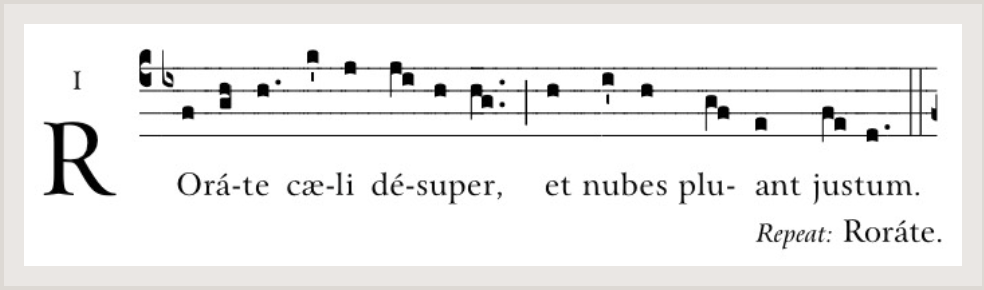
Drop Down Ye Heavens From Above is Judith Weir’s reworking of portions of the plainsong text and melody Rorate caeli desuper. In her notes attached to the Novello description of the work, Weir writes “[T]he music has a plainsong-like shape (although not based on any real plainsong).” A close look at the Rorate chant in the Liber Usualis, however, indicates that she quotes the music of the plainsong antiphon at both the opening and the close of her motet, setting a direct English translation of the appropriate Latin text. The material between these two statements makes use of words and music drawn from the original chant, artfully manipulated and reordered by the composer. The resulting whole is a synthesis of original chant material and the composer’s imagination.

Liber usualis

Drop Down, Ye Heavens, From Above, by Judith Weir
Singing plainsong, and music derived from plainsong, is not only artistically gratifying; it teaches a choir to sing with a flexible line, to pronounce text meaningfully, and to devote themselves to a clean, pure section sound. These style characteristics are invaluable, as an ensemble moves into the music of succeeding centuries.

Emerging Voices: Chicago Chorale Highlights Woman Composers
A number of the selections on our current program have been composed or arranged by woman composers. The best-known of them, Alice Parker (born 1925), worked with Robert Shaw for many years, arranging familiar tunes from many traditions for choral performance. Though both names are usually listed as arrangers on their many joint publications, I once heard Mr. Shaw say that Ms. Parker did all the work; he just cleaned it up for performance. Her simple arrangement of the Gregorian melody O Come O Come Emmanuel is just right, in every respect: she invests this well-known, well-loved hymn with warmth and dignity through antiphonal use of the men’s and women’s sections of the choir, enriching it harmonically but never weighing down the crystalline character of the chant. I have sung many, many of her arrangements, and invariably find them to be this good— respectful, unobtrusive, a joy to sing.


Alice Parker
A number of the selections on our current program have been composed or arranged by woman composers. The best-known of them, Alice Parker (born 1925), worked with Robert Shaw for many years, arranging familiar tunes from many traditions for choral performance. Though both names are usually listed as arrangers on their many joint publications, I once heard Mr. Shaw say that Ms. Parker did all the work; he just cleaned it up for performance. Her simple arrangement of the Gregorian melody O Come O Come Emmanuel is just right, in every respect: she invests this well-known, well-loved hymn with warmth and dignity through antiphonal use of the men’s and women’s sections of the choir, enriching it harmonically but never weighing down the crystalline character of the chant. I have sung many, many of her arrangements, and invariably find them to be this good— respectful, unobtrusive, a joy to sing.

Judith Weir
Judith Weir (born 1954), sets the plainsong Rorate caeli desuper (Drop down, ye heavens, from above). She begins with a simple fauxbourdon— the voices singing a perfect fourth apart, lending a distinctly medieval character to the piece. She then brings her setting forward several centuries by employing parallel thirds, evolving finally into a rich, 8-part climax before returning to something more akin to her language earlier in the piece. She departs further from her source material than Alice Parker does, but always with reference to the early source of the chant. Effectively, she presents a thousand years of European liturgical development in one short, inclusive setting of this Advent text; we sense the universal, ageless plea for salvation through her music, as well as through the words.

Elizabeth Poston
Elizabeth Poston (1905-1987), like Judith Weir, was English, but turns to early American shape note hymnody for inspiration in her anthem, Jesus Christ the Apple Tree. The angularity of her melody line, though not authentically pre-common practice (it is not, for instance, pentatonic, as many shape note tunes are), lends an overall impression of antiquity. One commentator on YouTube goes so far as to say the work is not original, rather a reworking of a pre-existent shape note tune, though I find no evidence for this elsewhere. Like Weir, she begins simply, adding harmonic complexity as she adds voices, then returning to unison (in canon) at the end. I find this piece more “composed” than the two preceding ones, more personal.

Undine Smith Moore
The fourth woman composer on our program, Undine Smith Moore (1904-1989), also excelled at arranging preexisting material— in her case, African American spirituals. Called the “Dean of Black Women Composers,” Ms. Moore was trained as a pianist and was active as a teacher throughout her career; it wasn’t until the 1950s that she discovered her knack for arranging of spirituals, which she transcribed as her mother sang them. An article by Helen Walker-Hill is quoted in a Wikipedia entry as stating, “[Moore’s] ‘black idiom’ was the use of additive and syncopated rhythms, scale structures with gaps, call and response antiphony, rich timbres, melody influenced by rhythm, the frequent use of the interval of the third and, less frequently, fourths ad fifths, non-homophonic textures, and the deliberate use of striking climax with almost unrestrained fullness.” I could not better describe the character of I Believe This Is Jesus, the piece Chorale will sing at our concert.

Back to Making Sausage
Structuring an Advent/Christmas choral program— choosing repertoire and presenting it coherently— is tougher than one might think. The theme is clear enough; the difficulty lies in presenting a series of short pieces related only by text, in a narrative order which must make stylistic sense and fulfill the need for overall tension and release, leaving the audience (and singers) satisfied at the end. And the individual pieces have to be satisfying, as well— some familiar, some challenging, all of them reinforcing our most “sentimental” holiday without slipping into the maudlin or manipulative.
Structuring an Advent/Christmas choral program— choosing repertoire and presenting it coherently— is tougher than one might think. The theme is clear enough; the difficulty lies in presenting a series of short pieces related only by text, in a narrative order which must make stylistic sense and fulfill the need for overall tension and release, leaving the audience (and singers) satisfied at the end. And the individual pieces have to be satisfying, as well— some familiar, some challenging, all of them reinforcing our most “sentimental” holiday without slipping into the maudlin or manipulative. A broad, general audience loves Christmas and celebrates the season through music; and though Chicago Chorale is not affiliated with any church or denomination, there are text and character expectations we must satisfy with our choices. Listeners and singers want to feel comforted, nostalgic, and uplifted.

Since Chorale began presenting Christmas concerts, four years ago, this planning has become one of the most difficult things I do. I poke around on YouTube, find programs of other ensembles, order single copies of newly-published music, ask friends and colleagues for suggestions. I consider the amount of rehearsal time we have, the fact that most of our singers will have been silent for several months before awakening and retooling their voices in the Fall (and the pandemic had many of them silent for more than a year!). And we have a large number of new singers with us this fall— which is temporarily destabilizing, though exciting in the long run. The many transitions involved in such a concert, the many musical styles, even the choreography— these considerations weigh heavily in the choices I make.
I begin with a long list, determine timings for individual pieces, set a time limit on the program, and then begin cutting. I move titles around, eliminate pieces for one reason or another, search out the right text or musical mood for a particular spot in the program, and leave open the possibility of changing my mind during the rehearsal period, if something doesn’t quite work. And I look outside of the rather austere body of repertoire from which I usually choose, hoping to appeal to a broader audience, and bring them into Chorale’s fold. It wouldn’t be Chorale unless we included music by such heavy hitters as Pärt, Vaughan Williams, Busto, Tavener, and Dubra; but much of what we sing at Christmas reflects a more popular or folk-based tradition, arranged or composed for SATB choir by skillful composers who have a particular feel for this work.
I love these concerts, and the enthusiastic listeners who attend them. Last year, the lack of communal music was a big hole, for all of us; I greatly look forward to being in the saddle again. I hope to see you in December!

Brave New World

The rubber has hit the road for choral groups this fall, as we meet after a year and a half’s hiatus, share space and air, plan concerts, wrestle with the possible and the impossible. It’s a brave new world, as each ensemble tries various solutions to the problems that confront us all.
Chicago Chorale is fully masked, fully vaccinated, and halfway through its preparation period for our Christmas concerts, December 11 and 12. We rehearse at Hyde Park Union Church, our home for the past several years, and I continue to be grateful for the acoustic properties of the church’s sanctuary, though we now tie ourselves in knots to utilize them. Venue, whether for rehearsal or performance, is a very special component of a choir’s sound— not only does it amplify and focus the choir’s sound for the listeners, but it is the space within which the conductor hears and evaluates the choir, and the singers hear themselves, and to which they respond when modifying their production to “fit into the sleeve of sound,” as Robert Shaw used to say. I was privileged to watch my college conductor, Weston Noble, and Mr. Shaw himself, time after time, as they prepared their rehearsal spaces before rehearsal, adjusting the curtains just so, moving the chairs a quarter inch this way or that, building temporary platforms because a singer had to be located just there to make the proper contribution. And with both conductors, it could be a frantic nightmare when doing a sound check in a new venue before a concert— adjusting an unfamiliar space so that it would enhance the choir’s sound appropriately. On one particularly memorable occasion, in the chapel at Rocamadour, in France, I had the misfortune to be placed in front of a large wooden box, which amplified my voice to a degree that had Mr. Shaw tearing his hair out and yelling at me for my “immodest voice.” He was mollified only when the offending box was hidden behind several blankets, muting my offending voice. His stage manager and all-around factotum, Harry Keuper, often commented that Mr. Shaw was “toilet trained at the point of a gun,” as he helped in setting the chairs.
The Centers for Disease Control and the American Choral Directors’ Association, which issue guidelines about how choirs should sit and stand and breathe in these fraught times, were not around when Hyde Park Union Church was built, the chancel steps designed, the pews bolted to the floor, the railings fixed in place, the air exchange system installed. Spaces are too narrow or too broad, too straight or too abruptly curving— and totally inflexible. Each Wednesday I spend two hours setting up, lugging chairs around, trying new configurations, eyeballing the 3-foot rule, trying to keep Chorale’s initial voice placement intact, making sure singers are not acoustically isolated or otherwise placed where they cannot function productively. And during rehearsal, I keep my eye on the singers to be sure that they, like me, are not so irritated with their masks that they unconsciously pull them down. And I keep my eye on the clock, so that active rehearsal periods are not too long, and breaks too short.
All of this while breaking in sixteen new singers, trying to enable social rapport and cohesion, learning new music, motivating the group to enjoy and look forward to rehearsals, and working toward a polished performance.
Through all of this, Chorale has, miraculously, been having a good time. We have extraordinary new singers, who contribute beautifully to our sound and our morale. Our repertoire is challenging, as always, but enjoyable to sing. And we continue to ride a wave of relief and euphoria that we are able to do this, and that the Wednesday night Zoom meetings are a thing of the past. The Covid 19 pandemic is unforgettable, and not in a good way; but we are excited about what lies ahead. Music does make everything better.

Chicago Chorale's Season Begins
Chicago Chorale will begin rehearsing for the 2021-22 season in just one week. Along with other ensembles in our area, and around the country, we plan a full season, with in-person rehearsals, a full schedule of concerts, and live audiences. It has been so long! since we sang together, listened closely to one another, learned new repertoire, experienced the transforming thrill of combining our talents for something so much bigger, so much better, than any one of us individually.
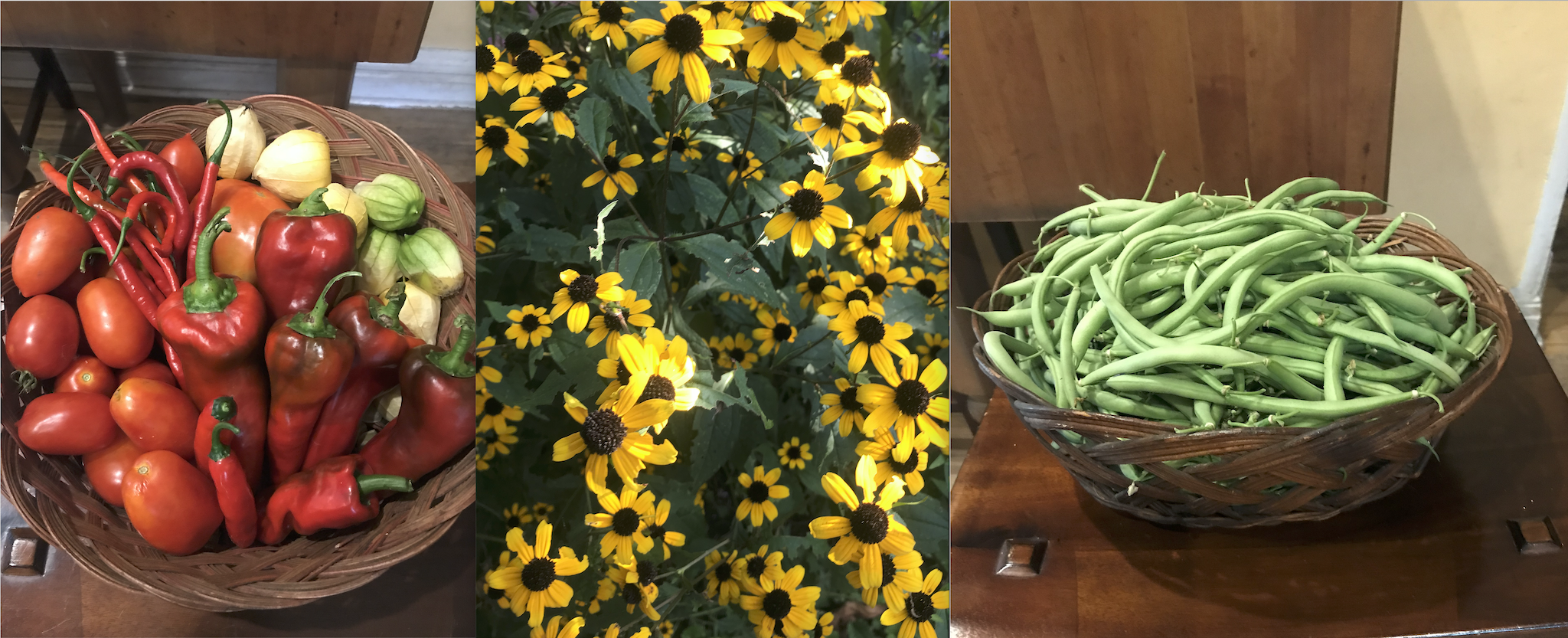
A late summer harvest from the garden. The end of one season, the beginning of another. Time for choir to begin!
Chicago Chorale will begin rehearsing for the 2021-22 season in just one week. Along with other ensembles in our area, and around the country, we plan a full season, with in-person rehearsals, a full schedule of concerts, and live audiences. It has been so long! since we sang together, listened closely to one another, learned new repertoire, experienced the transforming thrill of combining our talents for something so much bigger, so much better, than any one of us individually. It’ll take time for us to get to know one another again, to welcome and absorb our new singers (sixteen of them!), to reestablish our choral disciplines and feel like an ensemble; but the fundamental beauty and integrity of what we do— breathe life into the words, and into the lines and dots and spaces we see on the page, becoming the poets’ and composers’ voice— will catch us and buoy us up as we find ourselves once again.
Much will be different than it was two years ago. Every member of our group will be fully vaccinated against Covid; we will all wear masks during rehearsals, until the CDC and the City of Chicago tells us otherwise; we will sit in one spaced, single row, around the perimeter of our rehearsal space, rather than in three tight rows facing in one direction. We will have less time for rehearsal, more time for breaks. And we will not gather in tight groups to socialize. Some singers will be nervous and worried about the possibility of infection, and this may affect their enjoyment at being together again.
We’ll spend our first rehearsals rebuilding our sound— hearing voices with one another and placing them to establish our sections, assigning divisi past the normal SATB where the music requires it, listening for balance, hearing solo auditions. This kind of construction work happens every fall, and will be even more crucial after so long apart. It’ll take time and patience. But my fervent hope is that the beauty of the music we perform— some of it familiar and comfortable, in the spirit of the Christmas season; some of it new and challenging, in the spirit of Chorale— will invigorate us, imbue our efforts with confidence, and reawaken the wonder of live performance for our singers, and our listeners.
We will sing Advent Vespers at Monastery of the Holy Cross, in Bridgeport, on Saturday, December 4, at 5:15 PM. And we will present our Christmas concerts Saturday, December 11, 8 PM, at St. Michael’s, in Old Town; and Sunday, December 12, 3 PM, at St. Thomas the Apostle, in Hyde Park. Three acoustically splendid venues. We hope you’ll put us in your calendars, and hold these dates open to come and hear us.

Auditions for Season 2021-2022
Chorale is currently hearing new singer auditions for the 2021-2022 season. As usual, we will hear auditions for all four sections. After a year of singing remotely, on Zoom, we have finally been able to meet in person, and actually rehearse, ensemble, the repertoire we have prepared on our own for our videos, these past twelve months. These meetings have been so exhilarating for the current members! We will rehearse for a few more weeks, then break for the summer, and prepare for the return of normalcy in the Fall.

Chorale is currently hearing new singer auditions for the 2021-2022 season. As usual, we will hear auditions for all four sections. After a year of singing remotely, on Zoom, we have finally been able to meet in person, and actually rehearse, ensemble, the repertoire we have prepared on our own for our videos, these past twelve months. These meetings have been so exhilarating for the current members! We will rehearse for a few more weeks, then break for the summer, and prepare for the return of normalcy in the Fall.
As happens every year, we have had to say goodbye to members whose circumstances have changed, or who are moving away— in several cases, had already moved away, but were able to join us weekly via Zoom, from Hawaii, New Orleans, Cleveland, San Francisco, St. Paul— there are a few pluses to the pandemic. So we have some openings.
What sort of singer does Chorale want?
We want singers with excellent pitch memory and interval recognition, and sufficient technique to sing consistently in tune, without distortion or uncontrolled vibrato. We want singers with innate, comfortable rhythmic sense, who feel the rise and fall of the musical phrase and know, confidently, naturally, when to get in, when to get out.
We want singers who are confident enough that they are free to listen to the rest of the choir, rather than focus solely on their own singing. We want them to be able to “listen louder than they sing.”
We want singers who read music fluently—or, lacking that, read it well enough that they can, and will, work out problems on their own, and arrive at rehearsal far enough along that they can keep up with better readers.
Chorale wants singers who are unafraid of language, and will prepare foreign languages (with coaching in rehearsals)on their own, and be able to contribute to the choir’s efforts, rather than be in need of constant correction. Language is the singer’s greatest single gift , the thing that sets the singer apart from the instrumentalist and makes the vocal art special and irreplaceable. Chorale cares a great deal about language.
Chorale wants singers who commit themselves to regular, prompt participation. Tardiness and spotty attendance really drag a group down, inject an element of disrespect for the music, for the group, for the conductor. Along with this—Chorale wants singers who respect and admire one another, who are happy to work together, to face the same direction, listen to one another, and produce a unified product.
We want singers who are drawn to the music we program—who are moved, challenged, stimulated by great musical literature.
I purposefully leave vocal quality to last. Yes, Chorale wants good voices, with interesting color and dynamic possibilities. But we care somewhat more about the musician, than about the singer—we want our singers to place their voices at the service of the music, of the composer, of the ensemble, more than at the service of an abstract standard of vocal production. We want our singers to love their voices; we want them to love music even more.
Contact us, at chicagochorale@gmail.com, if you’d like to schedule an audition. I’d love to meet and hear you!


Coro Vaccinio
Members of Chorale haven’t sung together since March 11, thirteen months ago. Since that time, we have met virtually, on Wednesday evenings, to vocalize, greet one another, share news, and altogether maintain the social contract that is a choir. After a hesitant start, we began to produce virtual videos— the first, Bogoroditse
Dyevo, was completed and posted on May 4, and we have been producing and posting them regularly since then. That’s eight of them, with another due out within the next couple of weeks. That’s a lot of singing by yourself, for those who have participated regularly. It has gotten old. But it has been the activity available to us, given the pandemic and the facilities at our disposal.


Members of Chorale haven’t sung together since March 11, thirteen months ago. Since that time, we have met virtually, on Wednesday evenings, to vocalize, greet one another, share news, and altogether maintain the social contract that is a choir. After a hesitant start, we began to produce virtual videos. The first, Bogoroditse
Dyevo, was completed and posted on May 4, and we have been producing and posting them regularly since then. That’s eight of them, with another due out within the next couple of weeks. That’s a lot of singing by yourself, for those who have participated regularly. It has gotten old. But it has been the activity available to us, given the pandemic and the facilities at our disposal.
In the meantime, scientists have developed several vaccines at lightning speed, and Chorale members are getting themselves jabbed. One of our members, Fred Behlen, suggest we move to the Coro Vaccinio stage— that we find a way to rehearse together, in person, for those who are vaccinated (assuming most members would fall into this category), with other members joining us as their own vaccinations are accomplished. We set to work to locate an outdoor space with an acoustically reflective backdrop and protection from rain, with enough standing space to accommodate social distancing, bathrooms, a keyboard for pitches, and some privacy. Turns out the Lutheran School of Theology, right here in our neighborhood, has a suitable courtyard and can provide for our other needs as well. Fortunately, the days are getting longer, so we can get together in the early evening without artificial light.
A couple of weeks from now, when the air might be warmer, the light better, and more of our membership vaccinated, we’ll give it a try.
In the meantime, Alex is putting the finishing touches on our next virtual video, Wondrous Love, in a beautiful arrangement by Robert Shaw and Alice Parker, and I am planning the Sausage video that will follow it. If all goes well, both with the pandemic and with our outdoor rehearsals, that will mark the end of this virtual year. We are already planning dates, venues, and repertoire for our 2021-22 concert season, though nothing is set in stone— the key word is flexibility. We will roll with what comes.

Da pacem, Domine
Back in 2014, I planned a concert on the theme “Da pacem, Domine” for Chorale’s 2014-2015 season, to be repeated on our concert tour of the Baltic countries during the succeeding summer. The original proposal for a concert on this subject, came from Father Peter Funk, prior of Monastery of the Holy Cross, in Bridgeport. Chorale has had a warm relationship with the Monastery since we started up, twenty years ago; Father peter, then called Ed Funk, was an undergraduate student of mine at the University of Chicago, had sung in all of my choirs and been my conducting assistant. We love singing in the Monastery’s incredible acoustic, and had jumped at the chance to prepare repertoire for a performance there.
Back in 2014, I planned a concert on the theme “Da pacem, Domine” for Chorale’s 2014-2015 season, to be repeated on our concert tour of the Baltic countries during the succeeding summer. The original proposal for a concert on this subject, came from Father Peter Funk, prior of Monastery of the Holy Cross, in Bridgeport. Chorale has had a warm relationship with the Monastery since we started up, twenty years ago; Father peter, then called Ed Funk, was an undergraduate student of mine at the University of Chicago, had sung in all of my choirs and been my conducting assistant. We love singing in the Monastery’s incredible acoustic, and had jumped at the chance to prepare repertoire for a performance there.

Monastery of the Holy Cross, Chicago
The Da pacem text, and its German equivalent (Verleih uns Frieden)is set frequently by choral composers, and expresses a common, fervent wish:
Give peace, oh Lord
To our days
Because no one else
Can fight for us
But only you, our God.
Rather than plan a program consisting purely of settings of this text, I wanted to structure a contemplative, prayerful mood, reinforced by a variety of texts. Having begun with a setting of the Da pacem text by the Estonian composer Arvo Pärt, I wanted to feature another setting of the same words, to echo his text and theme. The Pärt piece is a major event— it requires a lot of time and listener involvement in an a cappella program; and I had already chosen several other big pieces, by such composers as Bruckner, Lauridsen, Persichetti, and Paulus. I needed a smaller, simpler, more intimate setting of the Da pacem text, to sustain the mood I was after.
I searched my personal files and Youtube, and made a list of settings I found, in Latin, German, and English. I was particularly drawn to a Youtube posting by a Spanish choir, of a setting by Javier Centèno, which featured only the incipit, the opening three words of the chant— Da pacem Domine: Give peace, O Lord.
The incantatory mood of his setting immediately grabbed me, with its simple harmonic language and its gentle but incessant repetition of these three words— the composer had captured the essence of the text, but without weighing it down, creating a mood which hung in the air long after the singers were done.
The Youtube posting included the composer’s name, and I found his contact information through a Google search. He immediately responded to my request for a copy of his piece, and I tried it— on paper, in my head— at several different points in the concert program, and finally decided to open with it— using it to establish the theme and mood for the performance.
I find Centeno’s piece to be almost Schubertian in its simplicity, and in its unerring sense of doing the right thing at the right time, just exactly the right amount. Centeno accomplishes so much in this very brief 41 measure piece. And Chorale found, over the course of repeated performances on our tour, that it wore well— we were happy to sing it, and audiences responded positively. We have performed other pieces by Javier since that time, and have a commission in works, in honor of our twentieth anniversary. We have always been gratified by his artistic voice. His is a name— Javier Centeno— with which you should become familiar.
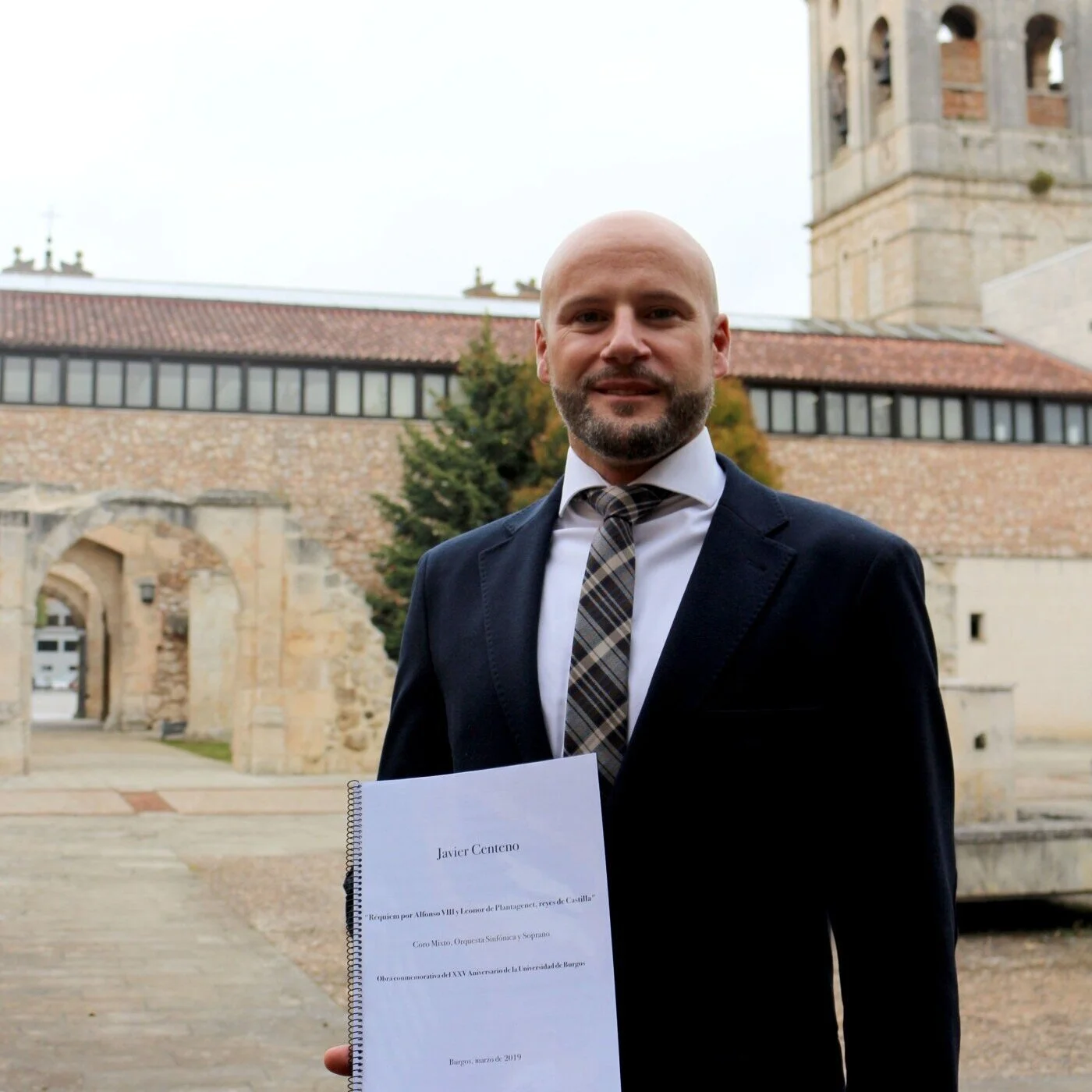
Javier Centeno, composer

One Year Ago
Chicago Chorale held its final face-to-face, pre-covid rehearsal on March 11, 2020. We were in the home stretch of preparations for our performance of the J.S. BachSt. John Passion, scheduled for March 27, at St. Michael’s Roman Catholic Church in Old Town. The venue, the vocal soloists, the instrumentalists, the rented portative organ, were all set to go. Plane reservations and local accommodations had been arranged; ticket sales were moving briskly. Chorale itself had been rehearsed to the point of clarifying every final consonant, measuring precisely every vocal ornament, refining each sound in the German text. We had prepared diligently, and were excited to bring our production to fruition. We were aware of the Covid19 pandemic, but naive about the radical changes ahead; like arts organizations all over the world, we hoped to be able to squeak under the wire. We didn’t realize the enormity of the situation about to engulf us.
Chicago Chorale held its final face-to-face, pre-covid rehearsal on March 11, 2020. We were in the home stretch of preparations for our performance of the J.S. BachSt. John Passion, scheduled for March 27, at St. Michael’s Roman Catholic Church in Old Town. The venue, the vocal soloists, the instrumentalists, the rented portative organ, were all set to go. Plane reservations and local accommodations had been arranged; ticket sales were moving briskly. Chorale itself had been rehearsed to the point of clarifying every final consonant, measuring precisely every vocal ornament, refining each sound in the German text. We had prepared diligently, and were excited to bring our production to fruition. We were aware of the Covid19 pandemic, but naive about the radical changes ahead; like arts organizations all over the world, we hoped to be able to squeak under the wire. We didn’t realize the enormity of the situation about to engulf us.

My experience of that final Wednesday rehearsal was heightened by a telephone call I received mid-rehearsal, informing me that my daughter, expecting her first child, had been checked into the hospital and had gone into labor, three weeks earlier than expected. I was fearful for her. My wife and I were able to go to the hospital and see her, and able to see her new baby two days later, March 13; but the hospital closed to visitors right after that visit, and we did not see mother and child again for several days, until they came home. We had a final family dinner at Pizza Capri, our favorite neighborhood restaurant, knowing that it would be closing the next day; the owner, Max Taleb, sat down at our table and told us he didn’t really know what he was going to do: continue with a take-out business or just close down. Our sons stopped attending school, and switched to the then-experimental online system, around our dining room table.


Chorale cancelled rehearsals and concerts, and cancelled our trip to Spain. I, and the rest of the group, were in a state of shock and disbelief; it took us a while to become rational and forward-looking. One of our tenors, Alex Luke, who had interest, experience, and equipment, suggested we try the new “virtual choir” format that was beginning to appear on Facebook, as a way of rallying our membership and supporters. We organized the group over email, and chose a piece (the Rachmaninoff Bogoroditse dyevo). Alex sent detailed instructions to the membership, and finally, on May 4, we posted our finished product. Over the ensuing weeks, we decided to continue producing similar videos. We also decided to produce interpretive videos, talking about the repertoire and the process. Our working title for this series of videos was Bruce’s Brats; or, How the Sausage is Made—and the name stuck. Alex came up with an image of sausages being grilled over a fire, and that became our brand. We also decided to institute regular Wednesday meetings, beginning September 16.
Here we are, a year later. Choir rehearsals are one of the riskiest of super spreader activities; but each day, more of our population is vaccinated, and local infection numbers decline. Illinois, under the leadership of our fearless Governor Pritzker, has done a good job tackling this situation. We fervently hope to be able to reconvene, physically, by next Autumn, to rehearse and present a full concert season in 2021-2022. This year off has taken a toll on us, and on everyone— we are all older, some singers have moved away, some have moved on to other activities and priorities. We will face new challenges; we’ll have new singers, we’ll sing new repertoire. We have learned that we are strong, that we have a solid base, that our twenty years of growth have given us the maturity to move fearlessly into the future. I’m looking forward to it.


Together
The sky today is a crisp, bright blue. Fresh snow covers the ground, but it melts rapidly in the strengthening sun. A day to look hopefully, energetically toward the future. The city’s major museums have announced that they will begin opening to the public, on a limited basis. The pandemic continues to rage, but the air carries the promise that it will, in time, burn out and we will be able to rebuild our lives and careers.
Chorale members zoomed in for our weekly meeting last night. We greet one another, talk about events and concerns, sing (muted, each member acoustically isolated from the rest of the group), discuss issues raised by our current project. We are preparing a video performance of a Kyrie eleison, adapted from music composed by Edvard Grieg for Ibsen’s play, Per Gynt. Each singer prepares the music on their own, then sings along with a piano version recorded by our accompanist, Kit Bridges, along with a video of me, conducting it. Audio and video versions from each singer are then mixed by our engineer, Alex Luke, culminating in the Hollywood Squares-type presentation you see on Youtube. Sound complicated?
The sky today is a crisp, bright blue. Fresh snow covers the ground, but it melts rapidly in the strengthening sun. A day to look hopefully, energetically toward the future. The city’s major museums have announced that they will begin opening to the public, on a limited basis. The pandemic continues to rage, but the air carries the promise that it will, in time, burn out and we will be able to rebuild our lives and careers.

Canada geese, together against the cold.
Chorale members zoomed in for our weekly meeting last night. We greet one another, talk about events and concerns, sing (muted, each member acoustically isolated from the rest of the group), discuss issues raised by our current project. We are preparing a video performance of a Kyrie eleison, adapted from music composed by Edvard Grieg for Ibsen’s play, Per Gynt. Each singer prepares the music on their own, then sings along with a piano version recorded by our accompanist, Kit Bridges, along with a video of me, conducting it. Audio and video versions from each singer are then mixed by our engineer, Alex Luke, culminating in the Hollywood Squares-type presentation you see on Youtube. Sound complicated?
This is how choir is done, nowadays. In the late summer and fall, when school and university ensembles were reconvening, choirs were able to rehearse outdoors, socially distanced, in drained swimming pools, parking ramps, athletic fields, even on Chicago’s Midway. Once cold weather settled in, however, these options were no longer available to choral groups. Some ensembles gathered indoors, wearing special “singer masks,” limiting their numbers and their time together, carefully cleaning and ventilating their rehearsal spaces. But the surge in covid cases as winter closed in discouraged most groups, and Zoom rehearsals and performances once again became the norm.
Chorale has completed six virtual projects and posted them on our Youtube channel, with a seventh currently in production. Even our upcoming gala, on March 24, will take place on Zoom. For the foreseeable future, until vaccination really takes hold and breaks the back of this plague, this is what we, and our fellow choristers and choral ensembles around the world, have.
We call ourselves an ensemble for good reason. The word means “together” in French, which meaningfully describes what a choir is, and does: we are together. We sing, and make music, together. The name of the popular American ensemble, Conspirare, says it all: we breathe together. And the toughest thing for us, these days, is to be and breathe together. Ensembles are not static entities— if they are not together, they tend to fall apart. With your help and support, along with the courage and discipline of our membership, we hang in there. We all look forward to better times ahead— but for now, we are learning, on the most basic level, the meaning and value of what we do.

Chorale and Kit Bridges, rehearsing together during pre-Covid times.

The Old Year Flees Away
Just one year ago, on January 8, 2020, Chicago Chorale was poised to dive into our 2020-20121 season. In my January 8 blog entry, I wrote:
“Chicago Classical Review has honored Chorale’s March 2019 performance of Vigilia, by Einojuhani Rautavaara, with the #2 position on their Top Ten Performances of 2019 list. Fantastic, that a volunteer group, operating on a shoestring budget, should be recognized in this way. We all know that the CSO, Lyric Opera, Music of the Baroque, Chicago Opera Theater, Bella Voce, and other local, professional ensembles consistently produce world-class performances of great music; to appear on this list with them is something we will always treasure.”
We began rehearsals that very night on the Bach St. John Passion, and were in the midst of making final arrangements for a tour of Spain in July of the following summer. Right up until our final face-to-face rehearsal, on March 11, we were pedal to the metal, preparing to celebrate our twentieth anniversary in grand style.
So much has changed in a year.
But some things have not changed. Chorale continues to provide its singers with a platform on which they can meet and make good music together, keep their skills and disciplines fresh, and enjoy interacting with one another. And we continue to provide our listeners and supporters with new content, new virtual videos, and fresh information about the music we perform, and about the way we perform it.
Like musicians the world over, we await a return to good health and safe performances, and ache to be able to present our audiences with live, vibrant performances. But we aren't sitting still, mourning lost opportunities, and watching our ensemble erode and disappear. The season of Christmas and the Winter Solstice is both the darkest and the most hopeful time of year; with one eye we face the worst, and with the other we look to the future, with hope and joy in our hearts.
This little boy, my grandson, was born March 13, just as our world was shutting down, Chorale’s big plans with it. I can’t think of him without thinking of the pandemic— in his bright eyes and fearless gaze lies the hope of the future. Like Chorale, he runs with the big dogs.
We have good things ahead of us.


Thanksgiving with the Chicago Children's Choir
Halloween, Thanksgiving, Hanukkah, Christmas, Kwanza, New Years— this is the season for people to get together, share good food, listen to music, enjoy family and friends, and fight off the gloom of shortening days and wintry weather. We are challenged, during these covid19-afflicted times, to find ways to do this safely.

Halloween, Thanksgiving, Hanukkah, Christmas, Kwanza, New Years— this is the season for people to get together, share good food, listen to music, enjoy family and friends, and fight off the gloom of shortening days and wintry weather. We are challenged, during these covid19-afflicted times, to find ways to do this safely.
Nearly every year since 1928, the Hyde Park and Kenwood Interfaith Council has sponsored a Thanksgiving Day service at Rockefeller Chapel. In a normal year, this service fills Rockefeller Chapel, and features prayers, readings and songs from the representatives of diverse faith communities, music by the Chicago Children’s Choir, and a keynote speaker. It is the single largest, most diverse gathering of our community, and effectively kicks off Hyde Park’s holiday season.
This year, the event will be on-line and virtual, and will feature Chicago Chorale! We are currently in the production stages of our virtual choral performance, collaborating with the Hyde Park neighborhood chapter of the Chicago Children’s Choir in a performance of Stephen Paulus’ beloved choral piece, The Road Home. Behind the scenes, this production is a technical marvel— each member of Chorale, as well as each member of the Children’s Choir, prepares, on their own, at home, their own video and audio contribution to the finished performance, which is then engineered and mixed by Chorale member Alex Luke, in his own home. Alex will send his finished product to those who are engineering the service, and the final production will be available for public viewing Thursday, November 26, at 11:00 AM on the Interfaith Council website, hpkinterfaith.org, . It will continue to be available for viewing, through the holiday weekend.
This year’s featured speaker will be Najeeba Syeed, Associate Professor in Muslim & Interreligious Studies at Chicago Theological Seminary. She will speak on Angelic Troublemakers: Interfaith Collaboration in Human Rights. Other participants will include Maurice Charles, Dean of Rockefeller Chapel, and representatives of the area’s various faith communities.

Najeeba Syeed, Associate Professor in Muslim & Interreligious Studies at Chicago Theological Seminary
Many organizations have been forced to shut down regular operations, and find creative ways to continue with their programming. Live musical performance has been hit so hard— and Chorale’s health is at the front of my mind, all the time. I think constantly about ways to keep singers and audience engaged. What a wonderful opportunity, to collaborate with these young people, and to serve the community from which we draw so much of our identity. I hope you’ll be able to tune in and hear us, and participate in the rest of the event.

Maurice Charles, Dean of Rockefeller Chapel

Chicago Chorale, Season 2020-21
In any other year, Chorale would be a couple of weeks into rehearsals for a Christmas concert, adjusting to new singers, learning new repertoire, planning ahead for the rest of the concert season. Brochures would have been sent out, instrumentalists hired for special events, promotional pieces already in the works. We had a number of special events planned for the 2021 season, which ushers in Chicago Chorale’s twentieth anniversary.
This isn’t any other year…

Virtual Choir recording of Rachmaninoff’s Bogoroditse Devo, recorded in April 2020
In any other year, Chorale would be a couple of weeks into rehearsals for a Christmas concert, adjusting to new singers, learning new repertoire, planning ahead for the rest of the concert season. Brochures would have been sent out, instrumentalists hired for special events, promotional pieces already in the works. We had a number of special events planned for the 2021 season, which ushers in Chicago Chorale’s twentieth anniversary.
This isn’t any other year. We are currently at the height of the Covid 19 pandemic, with no end in sight. Not only the United States, but the entire world, struggles to cope with a disease none of us expected, and with the enormous costs of this disease to our cultural life and economies. At the same time, global climate change is overtaking us at a rate for which we are not prepared, bringing with it severe weather, catastrophic fires and floods, droughts, and profound social upheaval. Political systems in our country, and in an alarming number of other countries, are under severe stress. Our sense of well-being, and hope for the future, are challenged as they have not been prior to this, in my lifetime.
Chicago Chorale isn't taking the situation lying down. Our last in-person rehearsal, before closing up shop and moving each to his/her own place of refuge, was March 11; we haven’t seen one another in person since. But we have been busy. The business of marketing ourselves, paying our bills, engaging our singers and audiences, continues unabated. Our managing director, Megan Balderston, continues with her never-ending grant-writing and fund-raising; and the singers and I have remained intact as a group, working one our own projects. We immediately went to work to produce our first ever virtual choir piece, an audio and visual recording of Rachmaninoff’s Bogoroditse Dyevo, sung by Chorale members from their own homes, mixed and produced by member Alex Luke, and released on Youtube and Facebook May 4. Since then we have released two more such projects: Pilgrims’ Hymn by Stephen Paulus, and O magnum mysterium by Javier Busto; we are currently working on another, and expect to release it about three weeks from now.
We are also producing a video series we call Bruce’s Brats: or, How the Sausage is made. I do a short, modified “program notes”-style presentation on each of the pieces we post, talking about whatever seems most interesting about the piece, its composer, its history— whatever comes to mind. I video these in my own home, then Alex refines them and produces the finished product. On August 27, the Ravinia Festival presented us in a broadcast concert on WFMT, heard by more than 6300 listeners, which featured selected recordings from the CDs which we have produced over the years.


The Sausage Being Made! Bruce’s kitchen, spring 2019.
I continue to write blog entries— not so frequently as when we are running at full speed, but every 2-3 weeks or so— on topics which seem pertinent to Chorale’s activities and history. I wrote a series in the spring and early summer about gardening as a metaphor for choral music, and later in the summer a series about the most noted and influential conductors for whom I have sung, and choral programs in which I have participated. This writing has been good for me; it has helped me to clear my head of the day to day pressures of running a choir, and focus instead on why I do it, and what it really means to me.
Three weeks ago, September 16, Chorale resumed weekly rehearsals— on line. We meet on Zoom, spend a few minutes greeting and reconnecting with one another, then warm up for half an hour (Kit Bridges, our accompanist, plays the warm ups on his piano, and each singer, muted, warms up in his/her own home). Then we talk about our current virtual project, go through announcements, and socialize a bit more, before returning to our private, pandemic-ordered worlds. It isn’t much; but I have been wonderfully stimulated, myself, to reconvene, to see familiar faces, to feel the eagerness and good will coming through the computer screen. We miss one another, and we miss our music making. Our relationships, and our music, remain alive, this way.
Music has so very important a role to play in the “sense of well-being and hope for the future” that I wrote about above. We need it now, more than ever.

The Baroque Performance Institute
My recent blog entries have focused on Chicago Chorale’s genealogy. Traditions and styles don’t just appear and assert themselves; whether we acknowledge our predecessors or not, they influence us and shape our work, as we in turn shape those who follow us. I have reflected upon the conductors and teachers with whom I have worked, and whose influence is reflected in Chicago Chorale’s approach to choral performance.
This week, I write about an influence larger than any single person: the Baroque Performance Institute at Oberlin Conservatory. Rather like a colony of honeybees, this 47-year old institution, comprising so many individual musicians, teachers, and students, is more important than any individuals I might feature. Unity of focus, and the combination of talent and insight, gathered under one umbrella, have made this organization an all-important generator of ideas, knowledge, and performance practice, influencing and disseminating lasting interest in the music of the 17th and 18th centuries.

Andre Bouys, 1710. National Gallery, London. Served as the visual logo for the Institute for 25 years.
As a graduate student at the University of Chicago, I sang with a small group of early music enthusiasts, under the leadership of Howard Mayer Brown, an important Renaissance scholar on the university’s faculty. Another participant in this group was Ken Slowick, a Chicago musician who specialized in baroque cello and viols (Ken is now the director of BPI). In 1978, Ken and Howard urged me to attend a summer session at BPI, where Ken was on the faculty, to learn more about performance practice of the Baroque period, and to work with Dutch baritone Max van Egmond, who was about to commence his long-time association with the Institute. I listened to a recording of Max’s rendition of the bass solos in the Bach B Minor Mass, realized this would be a wonderful opportunity for me to learn from a master, and signed up, though not without some trepidation—I was fairly provincial in my experiences and tastes, and embarrassed about that. But I had by that time spent several summers in the choruses at Ravinia and Grant Park, and noticed that singers around me who did not grow and move on, became stale and dissatisfied-- and I feared that might happen to me. So I drove to Ohio, and embarked on the first of eight summer sessions of challenging, fruitful study at Oberlin Conservatory.

Max van Egmond, baritone.
Most of what I encountered was completely new to me: historic tunings, especially the accepted baroque pitch of A=415; national styles; ornamentation and improvisation; vocal production that would allow singers to perform the fiendishly difficult music of the period; conductorless ensemble work—especially the close relationship between singers and continuo players (I had never before encountered the idea of continuo!); and a whole world of repertoire, the existence of which had previously been only hinted at in the pages of my college textbooks. I had several private voice lessons per week with Max, whose personal interest and example were invaluable; participated in daily master classes; rehearsed and performed with student ensembles; and sang small roles in “main stage” faculty concerts, under the direction of August Wenzinger, director of the Institute. I observed coaching sessions and rehearsals with other performers, and became acquainted for the first time with issues confronting players of period instruments. I particularly remember the energetic, insightful coaching I received from such teachers as organist Harald Vogel and violinist Marilyn McDonald, who changed forever the way I experienced music.

August Wenzinger, Director of The Baroque Performance Institute at Oberlin Conservatory
Just as important—I spent social, as well as professional, time with a community of deeply-committed musicians who cared for one another, treated me as a colleague, and who have continued to influence me in succeeding years. At one point, Mr. Wenzinger spent an afternoon with me, coaching me in songs of Hugo Wolf (1860-1903)-- hardly a baroque composer, but someone about whom Mr. Wenzinger had strong opinions and important insight. As he said at that time—music is music. And although I did not remain in the early music “fold,” I was deeply influenced by my BPI experiences in my succeeding choices of repertoire, in my preparation of choirs for the concerts of baroque and classical music Chorale does present, and in my hiring of contractors, concert masters, and players for those concerts, many of whom have participated in BPI, themselves.
Dalton Baldwin and Gérard Souzay; Robert Shaw; Helmuth Rilling; Margaret Hillis; Weston Noble; Max van Egmond; August Wenzinger—what a collection of foreparents stands behind Chicago Chorale! I often imagine what they might say in certain circumstances, wonder if they would approve of what I do, what criticisms they might have, what they might do or have done in my place. I have been blessed personally, through the role they have played in my life; more, though, I see myself as a conduit through which they influence those who sing under my guidance.

Weston Noble of Luther College
I first encountered Weston when I was a member of the 1966 Minnesota High School All-State Choir. Choral music was a big deal in Minnesota, and for many of us, All-State, which met at Bemidji State for one week each summer, was the pinnacle of what we would achieve. Our guest conductor was Weston Noble. We all knew his name: he was a legend in our Midwestern, Lutheran, mostly Norwegian American world. His college choir toured regularly through the Midwest, and he conducted a massive, all-city Messiah in Minneapolis each December. During All-State, I became aware of further connection: he rented a room on the Luther College campus from Magdalene Preus, my grandmother’s cousin, and was acquainted with many members of my family. Like the other participants in the program, I was swept off my feet by this young, 46-year old conductor, at the peak of his powers-- he knew exactly how to communicate with 17-year olds, and bring our musical performance to life.

Weston Noble
I first encountered Weston when I was a member of the 1966 Minnesota High School All-State Choir. Choral music was a big deal in Minnesota, and for many of us, All-State, which met at Bemidji State for one week each summer, was the pinnacle of what we would achieve. Our guest conductor was Weston Noble. We all knew his name: he was a legend in our Midwestern, Lutheran, mostly Norwegian American world. His college choir toured regularly through the Midwest, and he conducted a massive, all-city Messiah in Minneapolis each December. During All-State, I became aware of further connection: he rented a room on the Luther College campus from Magdalene Preus, my grandmother’s cousin, and was acquainted with many members of my family. Like the other participants in the program, I was swept off my feet by this young, 46-year old conductor, at the peak of his powers-- he knew exactly how to communicate with 17-year olds, and bring our musical performance to life.
I decided to attend Luther College, where Weston taught, and audition for choir, though I had no plans to study music, much less major in it. Arriving on campus, though, I was assigned a Music Department advisor, who convinced me to take first year music theory; and when I auditioned for choir, Weston suggested I take voice lessons. A year later, due to financial hardship, I moved out of the dorm and into Magdalene’s house-- and joined the Nordic Choir.
Weston was a regular fixture in my life, during the ensuing three years. I ate breakfast with him; rehearsed with his choir five days a week; shared a cat with him; watched the late news on TV with him before going to bed. I worked as student assistant in his office. He traveled frequently, to conduct festival choirs and attend meetings, all over the U.S.; when the travel was by plane, I drove him to the airport, and when the engagement was closer to home, I frequently drove him there and back. I talked endlessly with him, about my hopes and fears; he, in turn, listened, and counseled me, and talked about his own life and projects. My financial difficulties continued throughout college, and Weston always came to my rescue. When graduation came around, he was one of a handful of people who pushed me, hard, to attend graduate school at Chicago. And, a few years later, early in September 1977, he called me on the phone and offered me a job at Luther, conducting a new choir and teaching voice lessons.

As a college student, I was on the receiving end of his skill as a choral conductor, but never thought much about it. I had no intention of becoming a choral conductor, so I did not take notes. But an hour a day, five days a week, for three years, could not help but change me, and I absorbed a great deal; and maybe because I lacked an agenda, his conducting and teaching became more an integral part of me, than they would have, had I been at all calculating in my relationship with him. His exacting demands, his reductive techniques, his many stories and illustrations, became mine, though ultimately on my own terms, due to our very different personalities. He was small, well dressed and groomed; he loved driving expensive cars, was always tidy and careful, and circumspect in his social interaction. I was large and sloppy and careless, drove a junky car, was prone to hurtful social missteps. In other ways, though, we were very similar—in the integration of our emotional lives with our musical expression, in our restless insomnia, in our physical conducting gestures, in the close relationships we developed with our singers. We had different tastes and priorities, musically; leaving this aspect of him behind was a big part of my musical maturation, but it never came between the two of us personally.
I didn’t realize what I had, back when I had it: the opportunity to know another person, and such a formidable one at that, so well. I believe now it was best, that way. Naiveté allows us to be more porous toward the other.
As the years passed, Weston became more and more an eminence in the corporate choral world, speaking at conferences, accepting awards, becoming the public face of his profession. People wanted to meet him, be photographed with him, absorb some of his magic. My own professional trajectory was very different, and we inevitably grew apart. But the love and respect I felt for him, beginning when I was a teenager, though it changed and developed, never disappeared. A few years ago, not long before he died, Luther College presented me with the Weston Noble Award for achievement in vocal music education, and I treasure this award as much for the photo taken of us, as for the award itself. For so many years he helped and supported me; finally, it was my turn to support him.


Helmuth Rilling: We Must Be Together
The first summer I sang with the Shaw Festival Singers, a number of singers—some of our best singers—showed up a day late. They had just completed a three–week stint singing with the Oregon Bach Festival, and that was how travel arrangements worked out. I was immediately aware of these singers as a group of particularly successful, involved participants. They were young, mostly recent graduates of DMA conducting programs, on the hunt for credentials, resume lines, good jobs. During meal breaks, and around beers at the end of the day, they talked a lot about the Oregon Bach Festival, about the group’s organization, repertoire, and artistic director, Helmuth Rilling. They argued, sometimes heatedly, about the many differences between Mr. Shaw and Mr. Rilling.

The first summer I sang with the Shaw Festival Singers, a number of singers—some of our best singers—showed up a day late. They had just completed a three–week stint singing with the Oregon Bach Festival, and that was how travel arrangements worked out. I was immediately aware of these singers as a group of particularly successful, involved participants. They were young, mostly recent graduates of DMA conducting programs, on the hunt for credentials, resume lines, good jobs. During meal breaks, and around beers at the end of the day, they talked a lot about the Oregon Bach Festival, about the group’s organization, repertoire, and artistic director, Helmuth Rilling. They argued, sometimes heatedly, about the many differences between Mr. Shaw and Mr. Rilling.
I have often noticed that loyalties to particular conductors, even amongst professional singers, can be a very important aspect of the choral experience. Conductors encourage loyalty, sometimes manipulating their singers shamelessly and trashing the competition, while singers eagerly take sides, sometimes expressing irrational opinions. Both Mr. Shaw and Mr. Rilling inspired such heated fealty, though to give them credit, I was not aware of either trying to do so. For myself: I was grateful, even overjoyed, to have been chosen to sing for Mr. Shaw; and I became intrigued at the possibility of singing for Mr. Rilling. I wanted to learn technique and repertoire. So when, the following winter, I read an audition announcement for the Oregon Bach Festival Chorus in the Choral Journal, I immediately responded, prepared my materials, and flew up to Minneapolis to sing an audition.
The Shaw Festival had a very simple design: rehearse, perform, record. We, the choir, were the focus. The Oregon Bach Festival was far more ambitious. Designed by Managing Director Royce Saltzman, who was on the University of Oregon faculty, and by Mr. Rilling, it included conducting master classes, a youth choir, an organ recital series, a conductors’ forum, concerts and presentations by guest ensembles, and a series of more or less popular concerts, for a broader, summer festival audience, in addition to the “main stage” performances of major choral/orchestral works, conducted by Mr. Rilling. The professional chorus was only one part of the overall offering, albeit an important one. We comprised the chorus for the major works and for the master class rehearsals and performances, and rarely had time off from cramming notes and pounding our voices. The singers had to look out for themselves, keep their voices in shape, remain healthy, while around them swirled a bewildering amount of activity.
Looming over the entire project was the quiet but powerful presence of Helmuth Rilling. Assistants organized the master classes, prepared the chorus, administered the large number of available offerings; but his influence informed everything. It was a family affair for him: even his wife and daughters participated, setting a tone which became a major theme of the festival—that we were all together in this venture, sharing in a common goal. Helmuth considered himself a bridge builder—even, jokingly, wearing a hard hat at some events. One striking aspect of the experience for the performers was, that singers and instrumentalists lived and ate together, and treated one another as peers-- something I had never before experienced. The normal barrier between the two groups simply did not exist. Social interactions included all of us, just as musical events did.
We had only a fraction of the rehearsal time that we had with Mr. Shaw; there was simply too much music to prepare. We spent six hours a day with Mr. Shaw; we were lucky to spend six hours total with Helmuth, per preparation. He did not have a particular system for seating us, a rehearsal “method,” or easily recognizable principles; he just wanted us to sing the music accurately, with good German diction, at impossibly fast tempos. A couple of times I had the opportunity to sing with his German choir, the Gächinger Kantorei, in Germany and in Israel, and saw the same procedure there—sing through the piece, fix problems, regularize ornaments, emphasize text. Yet he managed, through force of personality and clear vision, to get what he wanted from us.
The totality of the work at hand was of paramount importance to Helmuth-- the structure, pacing, and meaning of the Bach Passions, for instance, took clear precedence over the techniques we used to express them. He always sought to express this meaning, through his interpretation, his pacing, what he said to us, the expression on his face. Mr. Shaw often said, “Sing the sounds of language, not the language itself;” I cannot imagine Helmuth ever saying such a thing. I took every possible opportunity to participate in master class rehearsals and performances—at least twice as many as were required of me—and did see more discussion of techniques there, in what he said and demonstrated to the student conductors. Mostly, though, he was simply more confident, more efficient, more commanding than they were: he did things better, not differently.
During my years with Helmuth, I sang a king’s ransom of Bach: both Passions, the B Minor Mass, Magnificat, motets, a tremendous number of cantatas; Mendelssohn’s Elijah, Mozart’s Requiem and C minor Mass, the Brahms Requiem, several Haydn masses, the Britten War Requiem, works by Bruckner, Penderecki, Tan Dun, Duruflé,-- and these are just the ones I pull off the top of my memory as I sit here at my computer. Others will surface later. One night after a concert here in Chicago I went out for a drink with Helmuth and his wife, Martina, and they asked me, Why do you leave your family, summer after summer, and come to spend three weeks in Eugene, Oregon? I answered, Because of the repertoire. Where else would I have such a rich opportunity? But at least as much as the repertoire, I treasured being part of the Togetherness that Helmuth sought through his work; part of his family. He built bridges I still use and love.


Margaret Hillis and My Introduction to the Chicago Choral Scene
I originally came to Chicago right out of college, to attend graduate school at the University of Chicago. The university, and the city, changed my life, and I have been grateful ever since to the people who pushed me into taking such a major step, and to the people who put up with me once I got there. But after a couple of years, it became clear to me that my future did not lie in earning a PhD in English. My college degree had been in vocal music, and I fell back on that-- it turned out I could actually make money singing, and enjoy what I was doing. I resumed voice lessons, after a two year hiatus; and my teacher, Elsa Charlston, urged me to work with Dick Boldrey, a repertoire coach, and to audition—everywhere, for everyone, to get a feel for auditions, to see what was out there, to find where I could fit in.
I originally came to Chicago right out of college, to attend graduate school at the University of Chicago. The university, and the city, changed my life, and I have been grateful ever since to the people who pushed me into taking such a major step, and to the people who put up with me once I got there. But after a couple of years, it became clear to me that my future did not lie in earning a PhD in English. My college degree had been in vocal music, and I fell back on that-- it turned out I could actually make money singing, and enjoy what I was doing. I resumed voice lessons, after a two year hiatus; and my teacher, Elsa Charlston, urged me to work with Dick Boldrey, a repertoire coach, and to audition—everywhere, for everyone, to get a feel for auditions, to see what was out there, to find where I could fit in. One of the most consequential early auditions I sang was for Margaret Hillis, director of Chicago Symphony Chorus. She accepted me, with professional status, which solidified my commitment to a musical profession, and I was inducted into a brand new world.

Margaret Hillis and Doreen Rao at Carnegie Hall
College choir had been a refuge: a kind, supportive home, populated by idealistic, emotional adolescents like me, overseen by a loving, benevolent conductor who, though a perfectionist, controlled his singers with kindness, prayer, flattery, and polite persuasion. Professional choral singing was a very different situation, and Ms. Hillis used very different tools. Her very considerable accomplishments were based upon high expectations, rigid regulation, threat, fear of failure, and an extraordinary degree of control and preparation. From the moment one arrived for rehearsal and signed the attendance sheet, one was in her hands—sitting according to a competitive rating system, marking scores according to her specific instructions, learning notes and words according to uniform, prescribed techniques. Rules governing attendance and rehearsal behavior were rigid and unforgiving. Punishment was swift. The singers, and our union, were her enemy, but a necessary and beloved enemy. Rehearsals could be exciting; they could also be both tense and boring. But always efficient. She and her assistants kept one hundred plus singers in line, and produced a high-quality product—a massive but precise, neutral, flexible version of the choral/orchestral masterwork in question, upon which the “maestro” (either our regular conductor, Georg Solti, or any of a number of A-list guest conductors), would then put his own stamp and character.
It was an efficient system, and produced good results. Ms. Hillis had studied with Robert Shaw, and I discovered, years later, that the two shared much in common. Both subscribed to intense, demanding preparation and rigid procedures; both believed that a group performed only as well as it rehearsed. Ms. Hillis accepted no nonsense from her singers and employees, and did not indulge in displays of passion and temper; but her intensity was never in question, and her anger and disapprobation found other outlets. I feared her, far more than I feared Mr. Shaw. I found, during my time as a professional chorister in Chicago, that other conductors and ensembles adopted a good deal of her character—she trained many of the city’s conductors, in her position as Director of Choral Activities at Northwestern University. Her precision, her level of preparation and organization, her overarching “roadmap” approach to projects, provided a standard to which many of them adhered. I sang for her only one year, but I learned a great deal, and when I formed my own first choir, back at my Alma Mater, I was as influenced by her, as I was by the traditions of the college, though I didn’t realize it at the time. She was tough in a way I could understand and appreciate. She got the job done.

Margaret Hillis