

An Important Minor Composer
In addition to major works by Duruflé and Bach, Chorale will sing some smaller motets by French composers at our June 9 concert. Among these is Dextera Domini, by César Geoffray (1901-1972).
I first heard Dextera Domini in the late 1980’s, when Rockefeller Chapel sponsored a choir from the University of Minnesota in concert. The group’s conductor, Thomas Lancaster, was noted for his wide-ranging, adventuresome taste in choral repertoire, and this particular concert program was no exception.

In addition to major works by Duruflé and Bach, Chorale will sing some smaller motets by French composers at our June 9 concert. Among these is Dextera Domini, by César Geoffray (1901-1972).
I first heard Dextera Domini in the late 1980’s, when Rockefeller Chapel sponsored a choir from the University of Minnesota in concert. The group’s conductor, Thomas Lancaster, was noted for his wide-ranging, adventuresome taste in choral repertoire, and this particular concert program was no exception. I customarily have a pencil in hand at performances and take notes about the repertoire, and this piece warranted a large star in the margin of the printed program. I later contacted Tom for more information, and found that he had actually visited with Geoffray in France, and had had a long conversation with him, which effectively fills some gaps in published accounts of his life and activities.
Geoffray manifested his musical abilities at an early age, and enrolled at the Lyon Conservatory at the age of thirteen, majoring in violin. He studied with composer Florent Schmitt, who in turn had worked closely with Claude Debussy, and obtained first awards in harmony and counterpoint under him. He later wrote that working with Schmitt formed his compositional and musical technique: clarity of harmony, clarity of melody, polyphony, love of music, "inculcating rigor, accuracy, correctness of writing and a certain elegance of the composition” (In “Cesar Geoffray "by François Jaeger / Editions PIF).
After leaving the Conservatory he lived the demanding life of a jobbing musician—playing, teaching, working as assistant conductor at the Casino de Lyon, and composing light music under a pseudonym for the Casino. He also participated in the founding of a new choir in Lyons, Les Fêtes du Peuple. In 1930, he was invited to join an intentional community of artists, Moly-Sabata, under the leadership of Albert Gleizes, where he remained for ten years. During that time, he was increasingly drawn to choral work, especially for young people. In 1932 he became director of the Lyre Ouvrière Bressane, and in 1936 the assistant director of the Chanteurs de Lyon. In September 1940, he was asked to present some musical entertainment, before and after a talk on Scouting, with forty girls and boys. His success with this performance inspired him to continue with this improvised choir, now called the French Scouting Choir. Geoffray became the National Master of Singing for the Scouts of France from 1942 to 1955. Out of this involvement he founded, at the end of WWII, the popular choral movement, À coeur joie, which became an international movement with more than 450 choirs spread over the French-speaking countries (France, Belgium, Canada, Lebanon, North Africa).
As he states in the preface to one of the collections of music he composed for this organization (over 1,000 original compositions and harmonizations), Geoffray's aim was twofold: pedagogical and social. He wanted to teach children to sing, by a clear and precise method, through a series of choral compositions of graduated difficulty. And he had a sincere social concern: he was convinced that group singing would heal the wounds of the World War by providing children with a positive activity around which they could gather and experience the joy of living.
Dextera Domini is typical of Geoffray’s style at the more sophisticated end of his spectrum. His text:
The right hand of the Lord hath wrought strength; the right hand of the Lord has exalted me. I shall not die, but live, and declare the works of the Lord.
is powerful, positive, and uplifting, and he sets it with very specific vocal and rhythmic gestures which clearly elucidate the words. “Rigor, accuracy, correctness of writing and a certain elegance” aptly describes the experience of this short motet. Geoffray learned Schmitt’s lessons well, and adds his own irrepressible, buoyant spirit to the mix. I am as impressed with this piece now, as when I first heard it.

Life with J.S. Bach
My parents had a record player and a handful of records. One each by Frank Sinatra, Dinah Shore, Steve Lawrence and Eydie Gorme. Louis Armstrong, and Judy Garland, plus a couple of Cuban rhumba and cha cha dance albums. Also a boxed set of Guimar Novaes playing Chopin, which had been a Book of the Month Club bonus. When I was in high school, I added a couple of Barbra Streisand records. And that’s it. I listened endlessly to all of these, lying on the living room floor at night, in the dark.

My parents had a record player and a handful of records. One each by Frank Sinatra, Dinah Shore, Steve Lawrence and Eydie Gorme, Louis Armstrong, and Judy Garland, plus a couple of Cuban rhumba and cha cha dance albums. Also a boxed set of Guimar Novaes playing Chopin, which had been a Book of the Month Club bonus. When I was in high school, I added a couple of Barbra Streisand records. And that’s it. I listened endlessly to all of these, lying on the living room floor at night, in the dark. I’m sure these performers, and the music they performed, profoundly affected my musical shaping, at least as much as the piano lessons I took and the school and church choirs in which I sang.
My mother helped me to buy my own portable record player when I went to college. I took the family records with me, and started to buy a few of my own at the college book store. Sergio Mendes; Blood, Sweat, and Tears; Simon and Garfunkel. I also ventured into “classical” music-- Kirsten Flagstad, Elisabeth Schwarzkopf, Dietrich Fischer-Dieskau; and a two-record set of the J.S. Bach motets, sung by an English choir, whose name I never paid attention to and don’t remember. These Bach recordings absolutely blew my mind, as we used to say. I played them repeatedly, for myself, for friends, while I studied, while we sat around my room drinking beer on Friday and Saturday nights. Though I went to a Lutheran College, we did not sing Bach in our choirs-- so these recordings were my formative introduction to Bach’s vocal style and works. Thanks goodness the performances were excellent: they made creases in my brain which I would never be able to erase.
My favorite of the motets was Komm, Jesu, komm, BWV 229. From the very beginning, it appealed to me as a perfectly balanced evocation of world weariness and pain, answered by joyous affirmation, faith and hope. I expect that most college-age students feel a good deal of the former, and it was exaggerated by the events and struggles of that time. The Viet Nam War, the civil rights struggle, the deaths of Martin Luther King and Robert Kennedy, the Kent State killings, formed the matrix of my college years, and I know that I, at least, felt little hope and joy in considering the future. I didn’t know that Bach’s motet was thought to have been composed for a funeral, but I surely felt that my world was preparing to die, and his text, written by Paul Thymich, greatly appealed to me:
Come, Jesus, come,
my body is weary,
my strength wanes more and more,
I long for your peace;
the sour path becomes too difficult for me!
Come, come, I will yield myself to you;
you are the true path, truth and life.
It was quite easy to see, and hear, that each line of text was matched to an appropriate musical idea, and to follow the progression of feeling from the darkness of the opening to the soaring lyricism of the final line. There was nothing abstract or ambiguous about it. This clarity really appealed to me then, and continues to do so, now. The difficulty of the piece is not in understanding it, but in executing it: the writing is so dense and complex, polyphonically, harmonically; the articulation so precise and demanding. The choir really has to be firing on all cylinders, and very sure-footed, to pull this off. Though very short-- the motet lasts about eight and a half minutes—the piece really qualifies as a major work and must be treated so, rehearsed as such, if it is to receive an effective performance.
I count it as my great luck, that I happened upon this piece so early in my life. It has accompanied me, as singer and as conductor, throughout my adult musical career. I have grown through it, and witnessed the impact it has on others. I am grateful to have yet another opportunity to perform it this spring, on Chorale’s June 9 concert.

The Sea We Swim In
As wonderful a piece of music as it is, Duruflé’s Requiem means more to me than the notes on the page would dictate. Music is not just pretty, escapist stuff that exists in a sheltered vacuum; high art, low art, in-between art, it is the very matrix in which we live. It doesn’t just accompany us: it runs in our veins; we swim in it, it sustains us. As I prepare for our coming concert, I relive those events of nine years ago; and I’m sure they live, as well, in the musical choices I will make, this time around.
The two principle works on Chorale’s June 9 concert, Maurice Duruflé’s Requiem and J.S. Bach’s double choir motet, Komm, Jesu, komm, though very different in most respects, are both meditations on death.
The Vichy regime, which governed France during the Nazi occupation during the early 1940’s, commissioned Duruflé to compose a symphonic poem; he chose instead to write a requiem mass, utilizing thematic material from the Gregorian Mass for the Dead. Always a self-critical perfectionist, Duruflé worked on it, very slowly, up to the time of the regime’s collapse, in 1944. After the end of World War II, he once again took it up, completing it in September, 1947. Though not specifically designated as such, it stands as a requiem for the war’s dead, much as Benjamin Britten’s War Requiem memorializes those who died during World War I.
I first encountered the Requiem when I was bass section leader of the Chamber Singers at Holy Name Cathedral, in Chicago. Cardinal John Cody died on April 25, 1982, and our director, Richard Proulx, programmed Duruflé’s requiem mass for the cardinal’s funeral. Few of us were familiar with the work, and we had to prepare it very quickly—the funeral took place on April 30. So I had little time to reflect upon the piece, beyond noticing that it was warm, comforting, and gentle in character, much like the Fauré Requiem, that the vocal writing was gracious and idiomatic—easy on the voice—and that the organ part was fiendishly difficult. I have had many opportunities to return to it in the years since, as chorister, soloist, and conductor, in many and diverse settings, with several different organs and organists. Each time I perform it, I am struck anew by Duruflé’s skill, and craft, in incorporating the plainchant melodic lines with his dramatic, virtuosic organ style, creating a seamless, wholly integrated work, which combines ancient and modern musical elements in such a fearless, compelling manner. And does so with music of extraordinary sensual beauty.
Chorale last performed this work nine years ago, on March 27, 2010. Three hours before our scheduled Wednesday dress rehearsal, I received a telephone call from the police department in Harrisburg, Illinois, informing me that my daughter and two of her close friends, on a spring break bicycle trip, had been struck by a van on a remote road in southern Illinois, and had been airlifted to trauma centers in Evansville, Indiana. My wife and a friend immediately left, by car, for the hospital; I had to stay and run the rehearsal. I had no cell phone at that time, so I gave my wife the phone number of Jacob Karaca, a member of the choir. Halfway through our rehearsal, his phone rang. One of the girls was dead, the other two severely injured; our daughter was in a coma, her life hanging in the balance. And then I returned to our rehearsal of Duruflé’s Requiem, a work which had suddenly taken on new meaning for me. We worked for another half hour, and then I had to stop, as the situation caught up to me. John Gorder, our pastor, came to the church; members of Chorale kicked in to arrange housing, meals, rides to school for our other children; to find me a plane ticket; to take care of our dogs and cats; to arrange a ride to the airport. I went home, and our phone was ringing, almost non-stop, with calls from reporters, family members, friends-- national news services had picked up the story, and news of the girls’ accident was being broadcast all over the country. I flew to Evansville and rushed to the hospital—my wife met me at the front door, and then we spoke with one of the surgeons, who wept as he told us that our daughter’s face had been broken like an eggshell. I was allowed in to see her—her appearance was one of the most shocking things I had seen in my life.

Our daughter pulled through. So did Julia, the second friend. When I was sure Kaia was going to make it, I flew back to Chicago, in time to conduct our Saturday night concert of Duruflé’s Requiem. Our pastor spoke to the audience before we began, telling them that we were dedicating our performance to the memory of Faith Dremmer, the girl who had died. The next morning I attended Faith’s funeral; afterward, I collected our other three children, and a friend, Bill Bennett, drove us back to Evansville, where we waited as Kaia recovered sufficiently to travel back to Chicago.
As wonderful a piece of music as it is, Duruflé’s Requiem means more to me than the notes on the page would dictate. Music is not just pretty, escapist stuff that exists in a sheltered vacuum; high art, low art, in-between art, it is the very matrix in which we live. It doesn’t just accompany us: it runs in our veins; we swim in it, it sustains us. As I prepare for our coming concert, I relive those events of nine years ago; and I’m sure they live, as well, in the musical choices I will make, this time around.

Domes, Bells, and Icons
The major work on Chorale’s upcoming concert is the Vespers portion of Einojuhani Rautavaara’s All-Night Vigil (Vigilia). In Orthodox tradition, the All-Night Vigil is a liturgy including both Vespers and Matins that prepares participants for a major feast day. Rautavaara (1928-2016), perhaps the best-known contemporary Finnish composer, composed Vigilia specifically in memory of St. John the Baptist, who announced the coming of Christ and then was beheaded by Herod, at the behest of Salome. The work was inspired by his visit, as a young boy, to the island monastery of Valamo, in Finland’s Lake Ladoga—an experience that remained in the composer’s mind as an overwhelming vision of domes, bells, and icons. Rautavaara’s stirring music has a raw, visceral, yet euphoric quality that is totally unique in twentieth-century a cappella repertoire.
Rautavaara composed the two sections of Vigilia for separate events, Vespers in 1971 and Matins in 1972, and later combined them into a single concert work. In his foreword to the published score, he writes:
The major work on Chorale’s upcoming concert is the Vespers portion of Einojuhani Rautavaara’s All-Night Vigil (Vigilia). In Orthodox tradition, the All-Night Vigil is a liturgy including both Vespers and Matins that prepares participants for a major feast day. Rautavaara (1928-2016), perhaps the best-known contemporary Finnish composer, composed Vigilia specifically in memory of St. John the Baptist, who announced the coming of Christ and then was beheaded by Herod, at the behest of Salome. The work was inspired by his visit, as a young boy, to the island monastery of Valamo, in Finland’s Lake Ladoga—an experience that remained in the composer’s mind as an overwhelming vision of domes, bells, and icons. Rautavaara’s stirring music has a raw, visceral, yet euphoric quality that is totally unique in twentieth-century a cappella repertoire.

Rautavaara composed the two sections of Vigilia for separate events, Vespers in 1971 and Matins in 1972, and later combined them into a single concert work. In his foreword to the published score, he writes:
“The All-Night Vigil ultimately stems from a vision-inducing childhood visit to the island monastery of Valamo in the middle of Lake Ladoga just before the Winter War in 1939; after that war Valamo no longer belonged to Finland. It seemed to me that the islands floated on air, and more and more colourful domes and towers appeared between the trees. The bells began to ring, the low tolling booms and the shrill tintinnabulation: the world was full of sound and colour. Then the black-bearded monks in their robes, the high vaulted churches, and the saints, kings and angels in icons…These images dazzled my ten-year-old mind and lodged in my sub-conscious, to re-emerge fifteen years later in the piano cycle Icons (Ikonit) and again three decades later when I was commissioned to set the Orthodox divine service, or All-Night Vigil. The archaic, darkly decorative and somehow merrily melancholy holy texts affected me deeply. By coincidence, the date set for the performance was the Festival of the Beheading of St. John the Baptist. The proper texts for that day had unbelievable, naively harsh and mystically profound passages.
“No instruments are used in divine services in the Orthodox church, not even the organ. Because of this, I wanted to use the choir in as varied a way as possible. There are numerous solos, most importantly the opening basso profondo; there are also tenor, soprano and alto [and baritone] soloists appearing singly and in pairs. The choir not only sings but speaks and whispers too. It sings in clusters and glissandi (a traditional feature of the ancient Byzantine liturgy). There is also a ‘pedal bass’ group that frequently sinks to a subterranean low B flat; the liturgical recitation features microintervals, and so on. In fact, this All-Night Vigil is closer in spirit and expression to the ancient and lost world of Byzantine chant than to the newer Russian chant which was not established as the accepted style until the 19th century.
“The patron saint of this All-Night Vigil, St. John the Baptist, is specifically referred to in the dramatic bass solos 0f the Sticheron of Invocation and the Irmosses. The variation technique I have used binds and structures all sections and songs of the work together into a vast mosaic. In the midst stand two figures: St. John the Baptist and the Virgin, Mother of God. They are surrounded by the apostolic congregation and on the periphery—through the mystery of ecumenical unity—by all of Christendom and all of Western culture.”
Chicago Chorale is now in its tenth week of rehearsing this extraordinary, electrifying work. It presents several daunting tasks. First: we work with a Finnish language coach, Johanna Hauki, to learn the Finnish pronunciation, as well as to discover and rehearse the word and phrase accents which determine the piece’s constantly shifting metrical structure. We also have to become familiar with Rautavaara’s wholly personal, compelling harmonic language; and the soloists have to learn to sing in the cracks between the half and whole steps to which they are accustomed. Along the way, we have discovered that the All-Night Vigil is not some difficult oddity, intended to stump performers and listeners alike; rather, it is a strikingly original and unusual piece—I have never heard or sung anything else like it. Rautavaara’s descriptive notes come closer than anything I can conjure up, to suggest the emotional, musical impact of this work on the listener. This dramatically engaging work, in constant motion, achieves, through passages of tender beauty as well as great, tragic power, a grandeur and universality seldom encountered in a purely a cappella work.
The contrast between this work and the others on our program could not be more striking. Each composer has a distinctive, compelling voice—from Arvo Pärt’s eerily motionless tintinabula, to Gunnar Eriksson’s whimsical folksong setting, to the lush neo-romanticism of Ola Gjeilo and Peteris Vasks, to the New Age improvisation of Tõnis Kaumann. One cannot escape the impression that the Baltic region is currently the cradle of some of the most important choral music being composed and performed. You owe it to yourself, to hear this music! Seriously sublime.

The Estonian Influence
Two of the shorter works in our upcoming concert are composed by Estonians: Arvo Pärt (b.1935) and Tõnis Kaumann (b.1971).
One of the most performed and celebrated composers currently working in the field of classical music, Pärt was born during the brief window before World War II, during which Estonia and the other Baltic countries were sovereign nations, before being taken over, first, by the Nazis, and then by the Soviet Union. The Soviet occupation profoundly impacted his musical development—little news and influence from outside the Soviet Union were allowed into Estonia, and Pärt had to make a lot up as he went along, with the help of illegally obtained tapes and scores, and under constant threat of harassment from the Soviet authorities.

His compositions are generally divided into two periods. His early works demonstrate the influence of Russian composers such as Shostakovich and Prokofiev, but he quickly became interested in Schoenberg and serialism, planting himself firmly in the modernist camp. This brought him to the attention of the Soviet establishment, which banned his works; it also proved to be a creative dead-end for him. Shut down by the authorities, Pärt entered a period of compositional silence, having "reached a position of complete despair in which the composition of music appeared to be the most futile of gestures, and he lacked the musical faith and willpower to write even a single note (Paul Hillier)." During this period he immersed himself in early European music, from Gregorian chant through the development of polyphony in the Renaissance. The music that began to emerge after this period—a date generally set at 1976-- was radically different from what had preceded it. Pärt himself describes the music of this period as tintinnabuli —like the ringing of bells. It is characterized by simple harmonies, outlined triads, and pedal tones, with simple rhythms which tend not to change tempo over the course of a composition. The work Chorale will present, Nunc dimittis (2001), is an outstanding example of Pärt’s later, tintinnabuli style. He converted from Lutheranism to Russian Orthodoxy, and became immersed in the mysticism of the latter faith. and began to set Biblical and liturgical texts, with an obvious faith and fervor which once again brought him into conflict with the Soviet regime.
In 1980, after years of struggle over his overt religious and political views, the Soviet regime allowed him to emigrate with his family. He lived first in Vienna, where he took Austrian citizenship, and then relocated to Berlin, in 1981. He returned to Estonia after that country regained its independence, in 1991, and now lives alternately in Berlin and Tallinn.
Pärt’s colleague, Tõnis Kaumann, is one of the best-known of Estonia’s younger composers. Active in several musical genres, Kaumann is also a baritone singer in the professional choral ensemble Vox Clamantis, which has performed and recorded much of Pärt ‘s work. Kaumann’s compositional style is classified as post-modern, and is characterized by a high degree of improvisation, humour and a keen sense of the absurd, while being deeply rooted in Gregorian chant and early polyphony. His musical tastes range from the medieval to post-bebop jazz and Abba. The work Chorale will perform, Ave Maria, displays this broad variety of influences, alternating between fauxbourdon-like passage for the choir, chant sung by tenor and bass soloists, and improvisation by three soprano and alto singers.

Darkness and Light
In planning repertoire for Chorale’s concert of Baltic music, I found the program becoming darker and heavier with each piece I considered. This seems inevitable, when dealing with music from the Scandinavian and Baltic regions: this is the nature of art that is born in a harsh climate of long, cold, dark winters; even music for happy events sounds sad and mournful.

Kaia Gjendine Slålien (1871-1972), a rural Norwegian woman noted for her encyclopedic knowledge of Norway’s native folk music
Two of the pieces on Chorale’s upcoming program have Norwegian roots.
In planning repertoire for Chorale’s concert of Baltic music, I found the program becoming darker and heavier with each piece I considered. This seems inevitable, when dealing with music from the Scandinavian and Baltic regions: this is the nature of art that is born in a harsh climate of long, cold, dark winters; even music for happy events sounds sad and mournful. I thought I needed something to lighten the program’s specific gravity, but nothing presented itself; so I declared my planning done, and put the program away, to concentrate on Christmas music. The repertoire continued to bother me, however, and over Christmas break I replaced one of the darker pieces with something more upbeat.
I chose to program Gjendines bådnlåt, a traditional Norwegian lullaby arranged by Gunnar Eriksson (b.1936), professor of choral conducting at the University of Göteborg, noted for his folksong arrangements and experimentation with choral improvisation. He writes: “This arrangement of Norwegian Lullaby(Gjendines Bådnlåt) was created in 1993, I think, in response to a request from Oslo Kammarkör and their fabulous conductor Grete Pedersen. At this time the choir was turning their attention to the treasure of the great Norwegian folk music. Their vision was for various composers to find a more contemporary approach to the music in new arrangements—to give the song a new costume, so to speak—which would bring the song out in the lime light. I was lucky enough to be one of several chosen composers who answered to the challenge. Soon it became clear to me that it takes courage to approach this wonderful lullaby—so I did the “unthinkable” and dressed my arrangement of this Scandinavian jewel with a bit of a Cuban touch, creating a new perspective on the song. To my delight the choir liked it a lot—and a new turn on an old folk tune was born.”
The “Gjendine” of the title refers to Kaia Gjendine Slålien (1871-1972), a rural Norwegian woman noted for her encyclopedic knowledge of Norway’s native folk music. She is remembered primarily for her relationship with Norwegian composer Edvard Grieg, who adapted many of the songs she sang in his piano music.
Ola Gjeilo (b.1978) is one of the most frequently-performed composers in today’s choral world. Born and raised in Norway, he moved to New York in 2001 to attend the Juilliard School, receiving a master’s degree in composition in 2006. His choral works are frequently compared with those of fellow composers Eric Whitaker and Morten Lauridsen, who share with him a crossover, New Age sensibility based on a melding of classical choral tradition with a love of film scores, popular song, and improvisation. He has said that his primary sources of inspiration are nature and cities; and though many of his texts are conventional, straightforward passages taken from the mass or other liturgical and biblical sources, he often names his works after cities or natural phenomenon which inspired or influenced his composition in the first place.
Chorale will perform SANCTUS: London (2009) on our next concert. Gjeilo writes, “London was composed on a cheap keyboard, for kids basically, that I had borrowed when I lived in London back in 2004. I was studying at the Royal College of music at the time, and was writing the piece on the side, following a commission from the Norwegian choir Uranienborg Vokalensemble. Somehow, that atrocious string pad really inspired me, and I’ve used it ever since, even after I got much more advanced equipment. I guess it’s not always about the quality of the gear.”
Gjeilo’s music is lush, harmonically rich, neo-romantic, large and theatrical in conception; he is no “holy minimalist,” following in the path laid out by Arvo Pärt and John Tavener. Yet one hears echoes of his countryman of a previous generation, Knut Nystedt (1915-2014)-- an inescapable solemnity and seriousness of tone, and a dark, emotionally evocative coloration, which are lacking in the music of his American colleagues, Whitaker and Lauridsen. Nystedt’s most famous motet, O crux, could easily have served as a model for much of London. Gjeilo’s music is easy on the ear, but surprisingly rigorous in form and scope. I become more and more drawn to it as we rehearse the piece. And Chorale enjoys singing it.
Saturday, March 30, 2019 at 8:00 PM
Covenant Presbyterian Church
2012 W. Dickens Avenue, Chicago
Sunday, March 31, 2019 at 3:00 PM
Hyde Park Union Church
5600 S. Woodlawn Avenue, Chicago

Music for the Polar Vortex
Chorale’s current preparation (to be performed March 30 and 31) features a cappella music that spans northern Europe from Norway to Finland and south into the Baltic states—a region which provides a rich treasure trove of repertoire for lovers of modern, progressive choral composition. We will sing the Vespers portion of Finnish composer Einojuhani Rautavaara’s Vigilia; Gjendines bådnlåt, a Norwegian folk song arranged by Swedish composer Gunnar Eriksson; Sanctus, by Ola Gjeilo, a Norwegian composer now residing in the United States; Ave Maria, by Tonis Kaumann, and Nunc dimittis, by Arvo Pärt, both Estonians; and Pater noster, by Latvian composer Pēteris Vasks . With the sole exception of Rautavaara, who died in 2016, these composers are currently active and productive. It is a unique and thrilling experience for Chorale to be involved with music which is so much a part of our own time, and composers who are currently developing their own distinctive styles and voices while influencing one another and setting the course for the future of our art form.
Pēteris Vasks (born 1946), Latvia's most prominent composer, is the son of a Baptist minister, and grew up while Latvia was controlled by the Soviet regime. He studied composition at the State Conservatory in Vilnius in neighboring Lithuania, as he was prevented from doing this in Latvia due to Soviet repressive policy toward Baptists. He started to become known outside Latvia in the 1990s, and now is one of the most influential European contemporary composers.
Chorale’s current preparation (to be performed March 30 and 31) features a cappella music that spans northern Europe from Norway to Finland and south into the Baltic states—a region which provides a rich treasure trove of repertoire for lovers of modern, progressive choral composition. We will sing the Vespers portion of Finnish composer Einojuhani Rautavaara’s Vigilia; Gjendines bådnlåt, a Norwegian folk song arranged by Swedish composer Gunnar Eriksson; Sanctus, by Ola Gjeilo, a Norwegian composer now residing in the United States; Ave Maria, by Tonis Kaumann, and Nunc dimittis, by Arvo Pärt, both Estonians; and Pater noster, by Latvian composer Pēteris Vasks . With the sole exception of Rautavaara, who died in 2016, these composers are currently active and productive. It is a unique and thrilling experience for Chorale to be involved with music which is so much a part of our own time, and composers who are currently developing their own distinctive styles and voices while influencing one another and setting the course for the future of our art form.

Peteris Vasks
Pēteris Vasks (born 1946), Latvia's most prominent composer, is the son of a Baptist minister, and grew up while Latvia was controlled by the Soviet regime. He studied composition at the State Conservatory in Vilnius in neighboring Lithuania, as he was prevented from doing this in Latvia due to Soviet repressive policy toward Baptists. He started to become known outside Latvia in the 1990s, and now is one of the most influential European contemporary composers. While he always felt a strong affinity for sacred music, he didn't feel free to express it through vocal music since it would never have been allowed to be performed under the Communist regime. Since the restoration of Latvian independence in 1991, he has turned his attention more and more to religious texts. Pater noster (1991) is his first sacred piece written in his mature style. Vasks' choral writing links him to the composers who have been described as "holy minimalists," a group whose music, while stylistically diverse, tends to rely on tonal and modal harmonies, is frequently harmonically static or slow-moving and is often linked to plainchant and ancient liturgical traditions.
In an interview reproduced on Youtube, Vasks was asked: “When did you compose the Pater noster and what meaning does its title hold for people today? “
Pēteris Vasks: It was in the eighties when my father, who was a minister, often asked – son, when will you compose „The Lord’s Prayer”? …I answered that I hadn’t matured enough to write it. And so the idea kept being postponed; my father passed away, and only after many years did I finally write Pater noster. That’s why for me the piece has a kind of duality – it is for my own father, and for our common Father. Pater noster is a prayer, and I have always thought that prayer is a spiritual concentration, an act of faith, asking for some guidance in this world where we all are lost. Sacred music and sacred texts were the first musical impressions of my childhood. When I began to study composition I quickly understood a fundamental thing. Namely, that in order to be spiritually free you must write instrumental music or at least something with folkloric texts, because in that political regime sacred music was simply forbidden. It was clear to everyone that if you write sacred music, it will end up at the bottom of your desk drawer and never see the light of day. But at that time for me it was more important to hear a live performance, to gain musical experience. For this reason I wrote almost no vocal music and, of course, even less sacred music. In my opinion writing sacred music is the highest responsibility… If true, deeply felt faith is not inherent in sacred music, if it lacks genuine conviction, then it is especially amoral. When my father encouraged me to do it, I wasn’t capable of experiencing it, for to me many other things seemed far more interesting... And then came the nineties, the regime fell, and an interesting metamorphosis occurred wherein many „court” composers of the previous regime stopped praising the (communist) party and suddenly became believers. Again, in the context where new rules came into play and new conditions encouraged writing of sacred works to the point of being almost a trend, I felt no desire to write something like that...
Chorale is experiencing Vasks’ work as harmonically rich, earnest, emotionally heartfelt—gratifying to listen to, vocally challenging to sing. Vasks paints with bold strokes on a large canvas. Originally intended to be sung unaccompanied, the score was later augmented with an optional orchestral part, the addition of which makes it even grander than the original (which is the version in which Chorale will sing it).
Saturday, March 30, 2019 at 8:00 PM
Covenant Presbyterian Church
2012 W. Dickens Avenue, Chicago
Sunday, March 31, 2019 at 3:00 PM
Hyde Park Union Church
5600 S. Woodlawn Avenue, Chicago

It came a floweret bright, amid the snows of winter
I expect humankind has observed the Winter Solstice ever since our early ancestors wandered out of Africa and populated the northern hemisphere. The gradual weakening of the sunlight, the shortening of the days and lengthening of the nights, the cold and ice and storms, the possibility of starvation, -- not only did it cause physical privation and hardship, it must have been metaphysically terrifying.
I expect humankind has observed the Winter Solstice ever since our early ancestors wandered out of Africa and populated the northern hemisphere. The gradual weakening of the sunlight, the shortening of the days and lengthening of the nights, the cold and ice and storms, the possibility of starvation, -- not only did it cause physical privation and hardship, it must have been metaphysically terrifying. Only the knowledge that, after reaching its lowest point, the sun would return to full strength, bringing warmth and health, could sustain people through the hard times—then, and now. We crave light, warmth, comfort, good food and drink, the company of friends and family, at this dark time of year. We long for a narrative that makes sense of this annual descent into night. And we crave celebration, defying the shadows and gloom.
Chicago Chorale’s Christmas program takes us on this journey, from darkness back to light and into the new year. Our first piece is also our most ancient-- a modern setting of the Gregorian chant, Veni Emanuel. “Come, ransom captive Israel, that mourns in lonely exile,” sets the scene, and prepares us for the miracle that follows, the fragile spark of life amid the desolation of winter.
A mysterious but constant image in the Christian version of this new life is she who bears it: Mary, the mother of Jesus. Mary inspires composers to their best and most creative efforts, and her inscrutable figure dominates much of the iconography associated with the season. Chorale’s program features several pieces, by Franz Biebl, Michael Praetorius, Anton Bruckner, Sergei Rachmaninoff, Herbert Howells, and Gustav Holst, which celebrate Mary’s role in the Christmas narrative.
Perhaps the most compelling image in the Marian tradition is the picture of Jesus, born in darkness, amidst poverty and deprivation, loved and protected by his mother. So unlikely, so fragile, so needful. Javier Busto’s O magnum mysterium perfectly describes the wondrous scene—“O great mystery, that animals should see the new-born Lord, lying in a manger.” Chorale will also sing the beloved American carol O Little Town of Bethlehem, Bob Chilcott’s Bethlehem Star, the Schemelli/Bach chorale, O Jesu so meek, and David Wilcocks’ arrangement of the Polish carol, Infant holy, infant lowly, before asking the audience to join us in singing Silent Night.
Some of our music sets philosophical texts, leading us to understand how we should feel about this miracle of light in the darkness. Nils Lindberg’s version of the traditional Swedish song, Den signade dag, tells us that “this blessed day, which is now upon us, comes to us from Heaven; he gives us his blessing, he lets us behold him.” Javier Centeno’s setting of Lux fulgebit assures us that “a light shall shine upon us this day: for the Lord is born to us.” Johannes Brahms’ setting of Est ist das Heil uns kommen her really nails it all in place: “Salvation has come to us from grace and sheer kindness. Works never help, they cannot protect us.”
And there are songs of celebration: Francis Poulenc’s exuberant version of Hodie Christus natus est, and Charles Wood’s arrangement of Ding Dong Merrily on High. We will invite the audience to join us in the tongue-twisting, brain-teasing Twelve Days of Christmas, before closing with Arthur Warrell’s classic arrangement of We Wish You a Merry Christmas.
We celebrate at this time of year because we need to. And there is no better way to celebrate, than by joining Chicago Chorale at Ravinia, December 15.

A Chicago Chorale Christmas!
This season, Chorale will present its very first Christmas concert. The Ravinia Festival, which, surprisingly, has an indoor, winter season, has invited us to sing on their BGH Classics Series, in Bennett Gordon Hall, Saturday, December 15, at 5:00 PM and 7:30 PM.
By Bruce Tammen

Chorale has never presented an actual Christmas concert. We have sung Messiah three times, and the Bach Christmas Oratorio twice; but never a bona fide, celebratory holiday concert, with pieces from a variety of periods and composers, specific to the season. Rather, beginning with our very first year, 2001, we have participated in Advent liturgies, usually at Monastery of the Holy Cross, and put our greater efforts into concerts presented the weekend before Thanksgiving.
This season, however, we are breaking with that in-house tradition. The Ravinia Festival, which, surprisingly, has an indoor, winter season, has invited us to sing actual Christmas concerts on their BGH Classics Series, in Bennett Gordon Hall, Saturday, December 15, at 5:00 PM and 7:30 PM. Our singers are overjoyed to finally have this opportunity to show what we can do, in a program combining music by the “high art” composers who are our bread and butter (think Brahms, Poulenc, Bruckner, Rachmaninoff) with favorite contemporary pieces by Biebl, Chilcott, Busto, and Holst, and settings of perennially popular carols like Lo, How a Rose, O Little Town of Bethlehem, and We Wish You a Merry Christmas. We even plan to ask the audience to join us in a carol sing along!
I grew up with such annual holiday concerts, and conducted them each year I spent with the Virginia Glee Club, in Charlottesville, where they were wildly popular with the community, as well as with the university. Here in Chicago, I have planned and conducted holiday concerts each December for several years now, with CMAC, the University of Chicago Glee Club. And each season, audience members comment on how much they enjoy the free-wheeling programming, the enthusiasm of the singers, and the good spirits it all supports during the darkening time of the year. The men of CMAC even decorate the church where we perform, putting up lights, wreaths, and a tree, present skits, and serve cookies and cocoa to the audience after the show. And then they follow it all with a famously raucous party to usher in finals week. Some of this, I fear, would not fly with the Ravinia Festival… but we’ll do our best to send our audiences home in good spirits, visions of sugar plums dancing in their heads, humming carols. We hope to see you there! Tickets, available through Ravinia, are selling fast; don’t wait until the last moment to purchase yours.
Program notes for this weekend's "Sealed Angel" concerts
Shchedrin accomplishes his purposeful combination of traditional elements with modern sounds, techniques, and procedures, so smoothly, and so unselfconsciously, that the listener is not jarred or confused by the result-- the music sounds very much of a piece, and unified in its impact.
Rodion Shchedrin (b.1932) composed his nine-movement cantata, The Sealed Angel, to commemorate the millennium of Russia’s conversion to Christianity. Despite the official atheism of the Soviet era, Shchedrin’s family had retained its religious identity--- his grandfather was an Orthodox priest, and he himself had been secretly baptized. At age twelve, he was admitted to the Moscow Academy of Choral Art, where he received a rigorous choral music education, singing sacred works both by Russian composers and by Bach, Haydn, Mozart, Schubert, but with nonreligious texts—“awful, new, especially written words by terrible poets—about the wonderful weather, the birds singing, the grass growing, praising the Motherland—just terrible!” In an interview with David Wordsworth, Shchedrin says that he had long wanted to compose a major religious work in the Russian choral tradition, exemplified in the major works of Rachmaninoff and Tchaikovsky, “but for the great composers of the time, Shostakovich and Prokofiev, for instance, this was impossible; such religious feelings could be punished very seriously. They had to write choral works called ‘Hymn to Stalin,’ ‘Hymn to Lenin,’ and such things. I finished my work in 1988 and wanted to call it a ‘Russian Liturgy’ but knew even then that it would not have left my desk, despite perestroika, so not even a religious title. I had no commission and no choir in mind at all.” He instead entitled the work The Sealed Angel, after a well-known story by celebrated novelist Nicolai Leskov (1831-1895). Leskov's story concerns a community of "Old Believers," a conservative sect that sought to keep sacred icons and texts free from the influence of modern reforms. The community’s greatest treasure is an icon of an angel, believed to provide healing and guidance. Outsiders come to know of this angel, and the community is denounced to state officials, who confiscate the icon, coat it with wax, and emboss an official seal onto the angel’s face. Ultimately, a famous painter of icons named Sebastian is able to restore the icon to its full glory and power. Though Shchedrin’s cantata borrows very little from the story’s actual content, his choice of the story’s title is far from random—the restoration of the icon in many ways reflects the restoration of Orthodox faith and practice, during the period of the Soviet order’s disintegration; and Shchedrin’s text features liturgical texts and prayers Leskow mentions in his book. One particular passage, “Angel of the Lord, may thy tears be poured forth wherever thou wilt,” heard in its entirety in both the first and last movements, and in abbreviated versions elsewhere, and set to the dominant musical theme of the work, comes directly from Leskov’s story—it is a prayer said before the icon by one of the story’s characters.
Fortunately, Shchedrin’s timing was good, and the degree to which his title hid his religious intent, sufficient. He was able to organize a performance of the work in Moscow’s Tchaikovsky Hall in 1988, the year of its completion, and the performance was well-received. Just four years later, in 1992, he and his cantata were awarded the Russian State Prize, by President Boris Yeltsin. The first American performance took place in Boston, in 1990, under the direction of Lorna Cooke de Varon.
Musically, as well as religiously, Shchedrin’s work looks backward at least as much as it looks forward-- backward toward the remarkable musical flowering in the realm of Russian Orthodox liturgical music during the late 19th and early 20th centuries, which in turn was based upon the traditional chant of the Russian Orthodox Church. This chant, which can be traced back to the 11thcentury, consisted only of unison voices singing sacred texts, clearly and continuously, with no accompaniment, harmonization, or musical procedures such as polyphony or canonic imitation, which might obscure audibility or meaning. But contact with western European music and musicians in succeeding centuries weakened this practice; by mid-19th century, Russian choirs generally sang four-part harmony, following prevailing Italian and German musical styles. Harmonized according to the western system of functional tonality, the modal system of the ancient chants lost its integrity, and the resulting music lost meaning and interest. Composers, conductors, and church officials, aware of this, worked in the waning years of the century to develop a new style of church music, which revealed and preserved the nature of the ancient sources, while adapting the best of what had come from the outside. This music reached its peak in the compositions of Rachmaninoff, Chesnokov, Grechaninov, and others, and was halted only by the Revolution of 1917, when the composition and performance of church music was banned.
The Sealed Angel clearly owes a great deal to this liturgical tradition. Though newly composed, rather than based on pre-existent chants, Shchedrin’s music sounds comforting and accessible to listeners familiar with the pre-revolutionary style-- his melodies and their modal harmonizations, the voicing of his chords, the free metrical nature of his rhythms, unabashedly hark back to the music of his models. At the same time, he adds much that is outside the strict liturgical tradition: broadly expressive accelerandos and allargandos, extensive atonal passages, and unpitched screams, along with foot-stomping and hand-clapping. More importantly, he uses a solo instrument (forbidden in traditional liturgical music) both as accompaniment, and as a character in the drama—perhaps voicing the spirit of the angel, or the spirit of God. Shchedrin says of this instrument, in his interview with Wordsworth, that he had wished to use a Russian folk instrument, “a sort of Russian pipe, maybe like your recorder,” which would evoke the Russian folk tradition, “the music of the countryside, the Russian peasants I heard around me as a boy.” He concluded that the instrument he had in mind “would create pitch problems for the choir and is not able to play fast music, a very primitive but beautiful instrument, but many technical limitations. So I decided to use perhaps the nearest Western equivalent, the oboe, but this can also be a flute.”
Shchedrin accomplishes his purposeful combination of traditional elements with modern sounds, techniques, and procedures, so smoothly, and so unselfconsciously, that the listener is not jarred or confused by the result-- the music sounds very much of a piece, and unified in its impact. One senses that its stature will only grow over the coming years, as more choirs and audiences learn of it and experience it.
Better all the time
The performance of great music is like the burning bush-- it burns but does not consume. It makes us better all the time.
A few weeks ago, one of my private voice students (who also sings in Chorale) spoke at some length with me, about his reasons for returning to private study. He is established in his life’s work, and does not seek to sing professionally; but he has sung pretty well for a long time, is appreciated and in demand as a choral singer. As he ages, he has come to realize that his technique is flawed, that he is doing some things, habitually, that lead him in the wrong direction, and that these problems will become more pronounced with passing time. He will not be a good singer for as long as he’d like, and this worries him—not just as a matter of personal accomplishment, but because he realizes he is not doing the repertoire justice, not fulfilling the composers’ demands. Through the course of our discussion, it became clear that this thoughtful singer understands that he is in partnership with the composer--- that the composer needs his good singing, as much as he needs the composer’s good music. Without performers, a composer’s work is lines and dots on a page. He realizes that the more profound and compelling that music is, the more it demands of the singer. The relationship stimulates both partners—both are challenged to rise to the level of the other.
Over the course of this discussion, I was reminded of my own path to being a performer. When I graduated from college I was directionless, with no vocational plans; I drifted into singing because it was something I knew how to do, something that could pay some bills and provide me with a social outlet. I had the good fortune to run into conductors, teachers, mentors, who were committed to great repertoire, and were happy to work with me and point me in the direction they knew best—toward honest performance of worthy music. Beginning with Howard Mayer Brown, at the University of Chicago, I began to think about, and feel, that the beauty of the music itself, and the genius of the composers who had brought it life, were reason enough to want to sing-- and that doing a good job with their music was sufficient stimulation for me to want to be a better singer. Through Howard I made contact with the Baroque Performance Institute at Oberlin Conservatory, where I came under the influence of August Wenzinger and Max Van Egmond; at the same time, I began to pursue study with Gérard Souzay and Dalton Baldwin, focusing on art song of the 19th and 20th centuries. A few years later, I began to participate in choral programs under Robert Shaw and Helmuth Rilling. In each of these cases, I was stimulated by the teacher/mentor’s commitment to faithful performances of great repertoire; I grew more than I ever could have, had I focused purely on vocal production or choral conducting technique. Repertoire brought me to life.
Last summer, as a part of Chorale’s current strategic plan, our members were polled about what aspects of the Chorale mattered most to them. Overwhelmingly, they mentioned repertoire-- the quality of the repertoire Chorale programs, and the growth they experience through learning to sing this repertoire. The Chorale experience is a big challenge for the singers, as well as for the conductor: we take on some pretty knotty stuff, and work very hard to turn it into presentable performances. What we do is not for everybody, or for every singer. But at our best, we build bridges of technical accomplishment and understanding between ourselves, our listeners, and our composers: bridges which enable the growth and exchange of spiritual perception, intellect, and emotion. As we wrestle with our music, and argue with our composers, we grow both inwardly and outwardly. The performance of great music is like the burning bush-- it burns but does not consume. It makes us better all the time.
The Second Time Around
I find great pleasure in returning to Shchedrin’s work, which we studied so intensely, as a previously unknown composition, back in 2012.
The Second Time Around—I remember that phrase as a song title from the 1960’s—“Love is lovelier the second time around…” Frank Sinatra and other singers of that era recorded it, and it seemed to be on the radio constantly—at least, on the stations my parents listened to. It has become an occasional ear worm as Chorale rehearses Shchedrin’s The Sealed Angel, not because it sounds like Shchedrin’s music, but because of the pleasure I find in returning to Shchedrin’s work, which we studied so intensely, as a previously unknown composition, back in 2012. In general, my feeling about repeating a work is, if it isn’t worth repeating, it wasn’t worth doing in the first place. If I don’t grow, and feel differently the second time around, either I am becoming stale, or the piece is akin to the shallow soil in the parable of the sower—the seeds come up quickly, but can’t withstand the heat or the drought. The Sealed Angel is good soil. Back then, it was really daunting for me to make sense of it—to find structure, guideposts, and to find the best way to conduct it. The score is bewildering—as I wrote last week, Shchedrin cares little for regularity or consistency; he writes down what he likes, and then may write something different in what one would expect to be a parallel place, the next time around, because he feels differently, and wants something else instead. I struggled to “get inside his head,” to feel and understand the motivation behind the changes and the nuances which constantly tripped me up when I first approached the work, to discover the overall sweep and direction of the piece. I find now, six years later, that I have internalized what I learned back then, and am far more comfortable with the work, and with Shchedrin’s idiom. My score—the same one I used then—is full of markings, of rhythmic groupings, of “eyeglasses” and other warning signs; and most of these are still “right”: I feel now as I felt then, and can make use of many of the decisions I made then. Some groupings and phrases change, and my understanding of dynamics has been somewhat refined, as I work with a different group of singers (one size really does not fit all)—but mostly I feel right at home. I am comfortable enough to feel less constrained by some of what he has written—his instructions are vague, even contradictory, and I agonized over this six years ago, fearful of doing the work injustice. I feel less constrained now. Numerous recordings which have come out since testify to the need for each conductor, each ensemble, to take its own stance relative to what Shchedrin calls “ 50 percent stupidity”—to find, and go with, what works. Steeped as I am in the tradition of J.S. Bach, I found it very difficult to just take off and do as I felt (exactly as Shchedrin himself does)—but I feel bolder, now.
Chorale has sung a lot of Old Church Slavonic since 2012—major works by Rachmaninoff and Steinberg, plus a number of smaller pieces by Chesnokov, Grechaninov, and Golovanov. Our singers are more familiar and comfortable with the sounds of the language than they were in 2012; and though the transliteration system used in the Shchedrin score is far different than that used by the editors of those other works, we recognize the equivalents, and learn quickly. Our language coach, Drew Boshardy, has become adept at working with us, at anticipating our difficulties and focusing on them, which is also a big help. And the singers are more familiar with the overall vocal approach required by the music-- so different from the lighter sound required by much of what we sing.
This relative comfort—on my part, on the choir’s part—allows, even invites, more freedom, and more enjoyment, in preparing the music. Time seems to fly by, in our rehearsals. We hope you’ll come to hear us, whether you heard us the first time around or not—find out for yourselves that this music is lovelier the second time around.
Rodion Shchedrin Discusses his Compositional Process
I find Shchedrin’s explanations helpful in understanding The Sealed Angel, especially in relation to the music of J.S. Bach, which has been so central to Chicago Chorale's repertoire.
 The following is excerpted from an interview Bruce Duffie conducted with composer Rodion Shchedrin (composer of the oratorio we are currently preparing, The Sealed Angel), when the latter came to Chicago twenty-eight years ago, in October of 1990, for performances by the Chicago Symphony Orchestra of a new work. The entire interview is available at http://www.kcstudio.com/shchedrin3.html.
“[Shchedrin] was a delight to talk with. He shared a big smile, lots of laughter and a few tears. His speech was a mixture of Russian-accented English with a better knowledge of German. Indeed, he dropped German words into his responses on several occasions and freely admitted that he speaks English in a primitive manner, adding, slyly, that his Russian is much better. But when listening to him – with concentration – it is easily possible to understand his thoughts and ideas…. I have left many of his mannerisms, awkward constructions and sentence fragments in the text.” Bruce Duffie.
“Shchedrin: I think music must be clever. 50 percent. And 50 percent must be stupid. But altogether it’s clever. Our poet, Pushkin, said that poetry must be a little stupidity. Then this is really great poetry. But I think because music is some part of mathematic, not only your feeling. All, without any exception, genius work, possible to make mathematic. Without this, this is just impossible. This is just improvisation. This is difference between improvisation and real composer, if you give some mathematic. But if it’s only mathematic, this is not music. This is something very difficult to explain, but I think that music must be clever. I think just with the inspiration, impossible to be real good musical work. And without mathematic, also it’s impossible. I think that Bach music is maybe 75 percent of mathematic and 25 percent of inspiration. I think this [the music of Bach] is highest point of music.
“I think that my score which is the best, that somebody dictate to you. Somebody, I don’t know who, told me this. The few of my works which I like the best, somebody dictate it to me. I just was little machine. Just write this because somebody, I don’t know, inside my head or outside, maybe in the sky, dictate me. Nothing else. But this is happy and lucky moment. Something, somebody, I don’t know, maybe is God, maybe is one of his friends. Something like this.
“In the process of the work, usually you must be satisfied, because in other case you stop it immediately. But after you know something may be wrong, you need clean piece of paper. Always is better like you write of him because the best idea and best realizing [of the] idea, best of all on the clean piece of musical paper. This is ideal. And you know, “Ahhh, this must be fantastic, great, unique”; and then you write, and something uncomfortable “Ahhh, something it’s a little wrong,” so you try a little change in something. This is difficult to explain, like make love – how is possible to explain how you make love? It’s impossible! It’s really some feeling, some … This is emotional thing. Yes, yes. It’s difficult to explain it, yes.
“It’s two things very important for me: first is reaction of orchestra, or if it’s not for orchestra, for chorus. I see and look how they react. If they just snoring and just want sleep it’s not good. But if you see that the eyes is fire and they like it, then is good. And second what is important for me: the reaction of audience. If I feel I took audience in my hand, that nobody cough, that everybody full of attention, then I think I win. And then critics say, “Ohhh, this is not too good, [uses syllables the way an American might say “da-da-da-da-da” or “yadda-yadda-yadda”] du-du-du-du-ze.” For me it’s important, of course, ’cause I am human being! But the two things most important for me is my relationship in rehearsal of the performance, and reaction of the concert hall audience. Because then you decide, this is a live music or this is artificial music – this is just notes on the five-lines score.
I reprint this because I find Shchedrin’s explanations helpful in understanding The Sealed Angel, especially in relation to the music of J.S. Bach, which has been so central to Chicago Chorale's repertoire. That extra 25% of “stupidity/inspiration” he assigns to his compositional style, compared to Bach’s, is important to keep in mind: while he places Bach at the very pinnacle of composition, he places himself much more in the inspired moment. I doubt Bach could have produced anything like even his known output, had he been waiting for dictation, or depending upon blank sheets of paper and the reactions of his performers and audience. And the resulting music, and our experience of it, reflects this difference. Bach’s genius shines from within, and even in spite of, a regular, pre-determined approach to composition (the 50%), and reflects a communal, even bureaucratic, motivation for music-making in the first place: Bach built music the way other people build buildings or roads. This aspect of Bach’s music makes it easier to understand, prepare, and perform. If one learns the rules and techniques, and follows his blueprint carefully, one will have music. Shchedrin cares little for regularity, consistency, “blueprint”: he writes down what he likes, in the moment, and hopes others will like it, too. At one point, a given phrase will end with a whole note; the same phrase will end with a half note on the following page, “just because.” Tempos are likely to change every few bars or so, and to change inconsistently—he indicates tempo according to his feelings at the moment, rather than in relationship to motivic materials.
None of this makes for better or worse; it just makes for different. What a “romantic,” emotional performer might do with Bach, in response to his feelings or the mood of his audience, Shchedrin himself builds into his own music. Sometimes this seems tyrannical– but the results are undoubtedly very beautiful and emotionally evocative.
Reawakening The Sealed Angel
We are beyond happy to be working on this piece again. Singers who were not with us in 2012 are in for a wonderful musical experience.
 Chorale is now two weeks into rehearsals for our June 9-10 presentations of The Sealed Angel, by Rodion Shchedrin (b.1932). We learned this work back in 2012, when we performed and recorded it—and it has sat in the back of my mind ever since, quietly demanding that it be heard again. Then, the relative obscurity of the work, and its strange title, were somewhat daunting: would audiences even be willing to listen to it? I remember first reading through it in rehearsal—singers were surprised and relieved to discover that it was hauntingly beautiful, promising lots of satisfying emotional and vocal involvement for them. Over the course of performing and recording it, we found that it also afforded a rare, thrilling experience for listeners; indeed, those performances were some of the most rewarding we have ever done, and earned a stellar review for us from Lawrence Johnson of Chicago Classical Review, who wrote, “Friday night’s performance of The Sealed Angel at Hyde Park Union Church offered one of the most transcendent, beautifully sung and immaculately directed choral performances of this or any other year.” A month later, our performance was designated Top Classical Performance of 2012. It is risky to commit ones group to a virtually unknown work, gambling that your risk will pay off three months down the road; presentation and marketing can turn into a major financial loss, if you guess wrong. Fortunately, we guessed right. And we are beyond happy to be working on it again, this spring. Singers who were not with us in 2012 are in for a wonderful musical experience.
Shchedrin, one of Russia’s premier modern composers, wrote this nine-movement cantata in 1988, in commemoration of the millennium of the conversion of Russia to Christianity. It received its premier that same year, and was awarded the Russian State Prize in 1992 by President Boris Yeltsin. Originally titled Russian Liturgy, the hour-long work references pre-1917 Russian Orthodox worship, with its sacred, Old Slavonic texts, chant-based melodies, and modal harmonies. Shchedrin comes from a religious family, which maintained the forms and habits of its faith through the Soviet era; his goal in composing this work was to enable a reawakening of orthodox Christianity, within the changing but still officially atheistic state. But rather than promote a literal resumption of this tradition, Shchedrin suggests a new approach to it, represented through his use of instrumental accompaniment, which would have been forbidden in traditional orthodox worship.
As the date of the work’s premier approached, Shchedrin became cautious concerning official censorship, and he changed the work’s title to the relatively harmless The Sealed Angel, after a well-known story by the celebrated Russian novelist Nikolai Leskow (1831-1895), thus veiling the work’s liturgical basis.
Leskow’s story concerns a community of “Old Believers,” whose greatest treasure is an icon of an angel, said to perform miracles of healing. The prohibited sect is denounced to the state, and the official seal is embossed onto the middle of the confiscated angel’s face. Though Shchedrin’s work is not programmatic, it explores the most ancient practices and liturgies of the Orthodox Church in its musical materials, and features liturgical texts Leskow mentions in his book. In both its monumental dimensions and subject matter, The Sealed Angel is rooted in the tradition of large-scale liturgical compositions, particularly all-night vigils, which were prominent up to the time of the Revolution, particularly as set by such composers as Tchaikovsky, Rachmaninov, Gretchaninoff, and Chesnokov.
The work is set for chorus a cappella, soloists, and “svirel”– a generic term for Russian folk woodwind instruments. The notes in the German edition from which Chorale is singing, translate “svirel” as ”Flöte,” and, indeed, most of the recordings of which I am aware utilize obligato flute, though a small-print footnote in the score states that “the actual instrument, whether a flute or a reed instrument, [is] open to choice.” I have decided to use oboe, rather than flute, for a couple of reasons. From a practical standpoint, an oboe is far easier for singers to tune to, than a flute, especially in the acoustically rich spaces in which we will sing; in addition, I find the somewhat straight and plaintive sound of the oboe more folk-like, than the rich, cultivated sound of a modern flute.
An Image That Fits The Music: A Guest Blog Post by Managing Director Megan Balderston
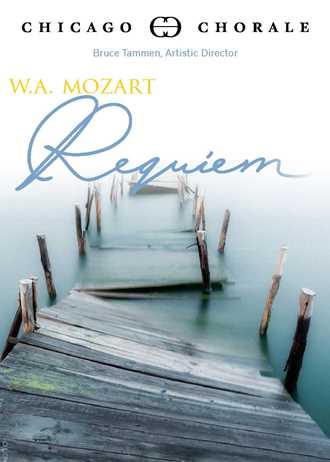 One of my unexpected “favorite” things about being Managing Director of Chicago Chorale is that of being the brand ambassador, which is a fancy way to say that I get to work closely with our graphic designer to pick the images around our concert and brochure artwork. Over the years this has turned into a labor of love for Artistic Director Bruce Tammen and me, who are often the final decision makers for our concert artwork.
I am certain we are not the easiest people to work with. For a recent concert, the direction I gave our intrepid graphic designer, Arlene Harting-Josue, was: “Can we come up with some abstract image that presents these concepts: something upwards and onwards. Something perhaps joyous, but seriously so. Not whimsical, not antique; but something fresh and modern and inviting.” Somehow Arlene can sift through this and give us some great ideas. And we know what we like when we see it.
The imagery for this concert was, therefore, a surprise. The Mozart Requiem is so iconic a piece, and despite the sadness of its subject matter, is not entirely sad. It is enshrouded in mystery. By its very unfinished nature, one always wonders what would have been, had Mozart lived to truly complete it. (See Bruce’s blog post about the Robert Levin completion we are using.)
Still, I was a bit surprised how the concert artwork affected our choir members when we presented it to them. For Bruce and me, the photograph was hands down our favorite in the mood it conveyed, and we didn’t ask about it. But the choir came back with: “What is the story of this image?” and “This image: I find it beautiful but it disturbs me, at the same time.” They asked me to go back to the photographer, Javier de la Torre, and find the story behind the photograph. Here is what he says:
“This pier is located in a really old fishing village called Carrasqueira, in the Alentejo area, close to Lisbon, Portugal. The piers have traditionally been maintained by the fishermen, but this particular pier is abandoned and no maintenance is done, so, nowadays, it doesn’t exist.
This shot was taken in 2010, and 3 years later, in 2013, I returned to Carrasqueira, but the pier was almost destroyed. Last December a great storm finally destroyed it totally, so, this shot cannot be repeated anymore.”
Knowing the story makes me appreciate our instinctive choice of the photo even more. For my part, I felt that the visual representation of the unknown structure of the pier beneath the surface, as well as the beauty of the colors, made for a striking and memorable image. Like music performed live, the photographer captured a moment in time that will never again be replicated. And Bruce? He says, “The feel of the image looks to me like the sound of the Lacrimosa movement.”
Interesting, ephemeral, and beautiful: much like Mozart’s music and his legacy.
Three motets for Passion Sunday
In addition to Mozart's Requiem, Chorale has chosen to sing three a cappella motets by modern composers, settings of texts appropriate to Holy Week, which have a musical and acoustical character particularly appropriate to St.Benedict’s Catholic Church, the venue for our concert.
In Mozart’s day, church music was not composed with concert performance in mind. Masses, vespers, requiems, passions-- all were composed for use in divine worship; divisions into separate sections, internal beginnings and endings, corresponded to the texts, which had specific functions in their respective liturgical observances. Composers were not thinking in terms of “movements” as we know them today; nor were they composing large-scale works which would take up an acceptable and convenient concert-length amount of time. Mozart’s Requiem is no different. Depending on the completion utilized, a complete performance, without inclusion of any extra-Mozartian liturgical materials, lasts between forty and fifty minutes. Modern audiences expect a somewhat longer concert; so the Requiem is usually paired with other, shorter works, sometimes by Mozart, sometimes not. Chorale has chosen to sing three a cappella motets by modern composers, settings of texts appropriate to Holy Week, which have a musical and acoustical character particularly appropriate to St.Benedict’s Catholic Church, the venue for our concert.

Two of these motets are by Knut Nystedt, who spent most of his life in Oslo, Norway, where he was organist at Torshov Church and taught choral conducting at the University of Oslo. He also founded the Norwegian Soloists' Choir and conducted it for forty years. But he is most recognized for his choral compositions, which are mainly based on texts from the Bible or sacred themes. Chorale presents two of his best-known works tonight. In Immortal Bach he instructs the choir to surround the concert hall in a single line, divided into five separate choirs, and sing the first eight bars of J.S. Bach’s setting of the chorale “Komm, süßer Tod;” then, through strict rhythmic augmentation and the resultant harmonic overlapping of the melody and harmony in the further course of the work, he creates a soundscape reflecting the eternal value of Bach’s music, as well as Bach’s Christian view of immortality. “O crux” sets a meditation on the cross by Venantius Fortunatus, 6th century poet, priest and Bishop of Poitiers, and is Nysted’s most beloved and performed work, especially during the Triduum, the three days between Maundy Thursday and Easter Sunday in Western Christianity. Nystedt explores the widest possible range in volume, pitch, and harmonic density, alternating between dissonant polyphony and rich, diatonic block chords, in expressing the pain and ecstasy of the crucifixion.
Our third motet is by Latvian composer Ēriks Ešenvalds, one of the most performed choral musicians working today. His complex, multilayered compositions, sometimes in eight or even sixteen parts, currently enjoy enormous popularity with choirs all over the world, with their rich, diatonic tonal color and lyrical melodic lines. He has a very busy schedule of commissions and public appearances, in addition to teaching composition at the Latvian Academy of Music. O salutaris hostia, a gentle setting of a portion of a eucharistic hymn by Thomas Aquinas (1255-1274), is one of Ešenvalds’ most successful pieces. Originally composed for female voices, the version for full choir Chorale will sing was completed in 2009. Two soprano soloists share the melodic material over a hushed accompaniment for full choir, alternately imitating and echoing each other.
We expect that the inclusion of these pieces on our program will not only enrich the listening experience for our audience, but will set Mozart’s very special, eighteenth century art in bold relief, against music composed two hundred year later, in a much different world.
Mozart Requiem Housekeeping
Last week I wrote about a conductor’s biggest decision, in planning a performance of Mozart’s Requiem: which edition/completion? But there are other choices to be made, as well.
Last week I wrote about a conductor’s biggest decision, in planning a performance of Mozart’s Requiem: which edition/completion? But there are other choices to be made, as well. Pitch level: it is thought that A equaled approximately 424 in Mozart’s time—about a quarter tone above what we now accept as baroque pitch (A=415), and a quarter tone lower than accepted modern pitch (A=440). These numbers were somewhat approximate and variable in their own times, as they are now—modern orchestras, for instance, seeking greater brilliance and excitement, edge up toward A=450, and even higher (much to the consternation of singers, especially tenors and sopranos, who are thus forced to sing higher than the composer intended, and cannot simply tighten the pegs on their voices). As a practical matter, instruments, and players, are available to play at several different levels; but they are rare, and not just waiting down the street; a presenting organization has to be willing to spend a lot of money to import such players with their instruments. The most difficult such instrument to account for is the continuo organ—instruments now are commonly built to be transposable between modern and baroque pitch, due to the burgeoning popularity of historically informed performance (HIP), but an instrument that is easily transposable to A=424 is rare; and it is difficult, and dangerous for the instrument, to manipulate such tuning on an instrument not built for it.
This adds up to lots of money and complication, and increased risk of failure. Chicago Chorale performs as authentically as our forces and finances allow: we present our Baroque oratorios at A=415 and import appropriate players and instruments if they are not available locally. But an A=424 Mozart Requiem is beyond our means. So we will perform it at A=440, with modern instruments which play in authentic classical style.
 Latin pronunciation: traditionally, American choral ensembles have pronounced Latin according to Roman ecclesiastical rules. HIP, in addition to introducing us to a wider variety of pitch levels and instruments, introduced us to national and chronological variations in Latin pronunciation. This can be an incredible can of worms for a larger chorus: which Latin this time—German, English, French, Italian? And is it the Latin of the 15th century, the 18th century, or the 21st century? And do we really know the specific practice for which the composer was setting his text? This is especially problematic with Austrian music, sandwiched as it is between German and Italian practice, both geographically and religiously. The majority of my experiences with
 Mozart’s Requiem were under the baton of Helmuth Rilling, who insisted on modern German pronunciation (even this has variations in it, and Helmuth’s pronunciation reflected his Swabian origins). But Robert Levin, who authored our completion of the Requiem, was often present for Helmuth’s rehearsals, and invariably begged to differ with his choice. He based his own opinion on North/South, Protestant/Roman Catholic issues: Salzburg and Vienna were Catholic cities, with Italian voice teachers and vocal style, implying, for Levin, that linguistic practice would have been Italianate. Mr. Rilling politely ignored Mr. Levin, and we pronounced the text according to German practice; but I have decided, for our coming performance, to go 100% Levin, and use the Italian pronunciation.
So many choices…
Mozart's Requiem, completed by Robert Levin
Why does the “Completed by...” line, following “Composed by W.A.Mozart,” matter so much, when we consider Mozart’s Requiem?
Why does the “Completed by” line, following “Composed by W.A.Mozart,” matter so much, when we consider Mozart’s Requiem? Scholars have long struggled to determine just how much of the Requiem actually belongs to Mozart. The composer’s final and unfinished work, it was commissioned by Count Franz von Wallsegg, who wished to have it performed, as his own composition, in memory of his dead wife. Mozart died before completing it; his wife Constanze decided to have it completed in secrecy, so that she could present it as Mozart’s work and collect the commission fee. Four musicians—friends and students of Mozart—aided in the hasty work of finishing the piece. Foremost among these was Mozart’s assistant, Franz Xaver Süssmayr (1766-1803); he was aided by Jakob Freistädtler, Joseph Eybler, and Abbé Maximilian Stadler. Their completed version of the Requiem was sent to the Count under a forged signature in Süssmayr’s hand, after Constanze had it copied. It is in this version that more than two centuries of listeners have encountered the Requiem.
Not long after, however, Süssmayr and Constanze came clean about what they had done, claiming that other than a “few scraps of music” which Constanze had handed over to Süssmayr, those portions of the original manuscript that were not in Mozart’s hand, were completely Süssmayr’s work. This prompted counter-claims from outside observers, who declared that Süssmayr was not a good enough composer to have produced this music. On the one hand, they acknowledged such Süssmayrisms as clumsy voice leading; thick, muddy orchestration; and conflicts with normal 18th century church music practice; but the fundamental nature and quality of the music, and the integration of musical motives throughout the work, were not similar to that on display in Süssmayr’s other works.
Spurred by Wolfgang Plath’s unearthing in 1960 of one of the “few scraps of music,” a number of musicians have attempted to eliminate from the Requiem the deficiencies introduced by Süssmayr, replacing them with music that is more in keeping with the Mozartean idiom. These “completers” include Robert Levin, Franz Beyer, H.C.Robbins Landon, Richard Maunder, and Duncan Bruce. Each has focused on universally acknowledged problems, proposing interesting solutions. Levin’s completion has gained considerable traction among top tier performing groups; Levin presents convincing arguments for the decisions he has made, and his finished completion acknowledges both the work’s traditional reliance upon Süssmayr, and the findings of more recent musical scholarship. This is the completion Chorale will present at our March 25 performance.
Süssmayr was no Mozart, to be sure. Still, we have little reason to doubt that Mozart discussed the Requiem with Süssmayr, and may even have given him detailed instructions concerning the unfinished sections. If nothing else, Süssmayr’s completion is an authentic 18th-century work with 200 years of performance tradition behind it. For these reasons, Levin is at pains in his 1996 completion “to revise not as much, but as little as possible.” Levin, a Mozart pianist (on the fortepiano) renowned for his spirited piano concerto recordings and brilliantly improvised cadenzas, approaches the Requiem with the goal of clarifying the choral component by thinning out the excessively dense texture of much of the orchestration completed by Süssmayr et al. Levin’s lighter, more transparent instrumentation places the voices at the expressive center of the piece. Levin has also composed an entirely new Amen fugue for the close of the Lacrimosa to end the Sequence, based on the recently discovered “scrap of music.” This new fugue follows 18th-century practice in that it is non-modulating, and completes a structure in which each major section of the Requiem culminates in a fugue.
I personally have sung the original Süssmayr, the Beyer, and the Levin completions on numerous occasions. I can promise that the spirit of Mozart reigns over each of them. Caught up in this spirit, neither the listener nor the performer stands outside of the work, observing or judging the completion at hand. The shattering impact of this music exists outside and beyond such viewpoints, valuable though they are.
Weaving gold from straw
Mozart must always be in control; the singer is the beautiful conduit for Mozart’s voice, not for his or her own.
 From grad school on, I worked with a very successful, recognized voice teacher. He was a good pedagogue: he had a good ear for vocal health and production, he recognized talent, he had an instinct for appropriate repertoire; he seemed to be able to predict a voice’s development, and to guide his students accordingly. He was insightful, empathetic, and fundamentally kind, and was able both to encourage his singers, and to let them down gently, but firmly, when they didn’t make the grade. He attracted top prospects to his institution and his private studio; his better students won competitions, and were cast by major opera companies; and he was adept at placing those who wished to teach, in good positions. He seemed to make good choices, and to position himself strategically in a very competitive market.
I frequently arrived early for my lessons, and would take advantage of the opportunities to watch him teach. A particularly talented soprano often preceded me, and I enjoyed hearing him interact with her. She had her own ideas about what she wanted to sing, about the singer she wanted to be-- and was frequently at odds with her teacher. She would bring in arias he did not assign, and sing them inappropriately—and he would have to bear with her, talk her down, try both to help her sing better, and to be more realistic about her talent. One day, shortly before the Met regional auditions, she brought in “Ach, ich fühl’s” from Mozart’s Magic Flute, and announced that she was going to sing it for the competition. He had her sing it, worked on a few passages, and then told her it was not her aria. I remember so clearly the gist of what he said:
Every soprano wants to sing this aria. It is absolutely perfect, musically and dramatically-- the Holy of Holies; if you nail it, you’ll have everyone swooning. But the opposite is also true: if you don’t absolutely nail it, everyone hears that, as well. You will be compared to every soprano they have ever heard, judged on your ability to sing it as perfectly as the greatest soprano that ever sang it—and inevitably you will fall short. Almost no one wins with this aria—and you certainly will not.
I have thought a lot about this incident over the years—both about the teacher’s response, and about singing Mozart. He was being practical, calculating-- she was talented, and might do well, given the right repertoire—something that would allow her more breathing room, that would make a virtue of her idiosyncracies and imperfections, that would allow her to color outside of the lines without penalty. But Mozart’s music simply does not allow this: it must be sung with complete control and fidelity, and with no hint of the heavy lifting that lies behind that fidelity. Mozart must always be in control; the singer is the beautiful conduit for Mozart’s voice, not for his or her own.
As Chorale prepares Mozart’s Requiem for performance on March 25, I obsess about this fidelity. As I admonish the choir during rehearsals-- the lines and voices at this point in our learning process sound like “twine”-- they are present, they work, but they have lumps in them, they have strands escaping from the central thread, they have weak stretches and frayed ends. Woven together, they yield a thick, opaque texture, far from the crystalline purity Mozart requires. Our goal, our necessary end product, is a transparent, shimmering structure, woven of silken threads—functioning individually, and in tandem, to express Mozart’s vision. Mozart challenges us to leave ourselves, and the weight of our imperfections, behind. Effectively, we weave gold from straw.
As Salieri expresses in the movie Amadeus, life is not fair. We can’t all be Mozart. But Chorale is doing its best to be a worthy vehicle for his voice and vision. We hope you’ll come on March 25, and share that vision with us.
Chorale at the Merit School of music
Last Saturday, Chorale performed for the student body at Chicago’s Merit School of Music, in the west loop. Many music lovers, even in Chicago, don’t know anything about this school; I know I was surprised when I came to their facility and saw what was going on.
 Last Saturday, Chorale performed for the student body at Chicago’s Merit School of Music, in the west loop. Many music lovers, even in Chicago, don’t know anything about this school; I know I was surprised when I came to their facility and saw what was going on. From the school’s website meritmusic.org:
Alice Pfaelzer and Emma Endres-Kountz founded Merit School of Music in 1979 in response to the elimination of music education from Chicago’s public elementary schools. Alice and Emma devoted themselves to helping young people realize their musical talents; use their musical skills to gain access to college; and become productive, compassionate, and responsible members of society. As personal role models they demonstrated that self-esteem and success comes from hard work and achievement. For more than three decades, Merit has advanced their vision.
Chorale sang for the conservatory students, described elsewhere on the website:
The Alice S. Pfaelzer Tuition-free Conservatory is the culmination of Merit’s instructional continuum and represents the best of Merit’s talented student musicians…For 26 Saturdays during the academic school year, Conservatory students receive instruction from Chicago’s finest music educators in large ensembles, instrumental and vocal technique classes, music theory classes and a variety of elective classes, including chamber music, composition and piano as a second instrument—all tuition free. At noon each week, the entire student body comes together for Live from Gottlieb, a concert series featuring world-class musicians from Chicago and beyond.
That’s us, in that final sentence. The concert occurs right before lunch, and lasts about half an hour. One might expect 350 adolescent-age kids to be restive and disruptive at that particular time of day—but at Merit, one would be pleasantly disappointed. They were completely engaged in our performance—one could have heard the proverbial pin drop, when we weren’t actually singing. We presented music from our Autumn concert, which we refreshed for this particular gig, and the students responded with enthusiastic applause at the end of each piece. I was very impressed, not only by their behavior, but by their appreciation.
One anticipates an engagement like this with all kinds of trepidation: how will the hall be? Will the acoustics be decent… How will the piano be… in tune at all? Will the kids laugh and interrupt and throw paper airplanes at us? Will the singers tense up, lose confidence and good will, and be unable to perform well? Over the years I have participated in concerts at public and private schools, both, where all of these things, and more, were a part of our regular experience. Administrators can say, or write, anything they want, about the high level of their students and institution; you find out for yourself when you walk on to the stage, and face them. I walked out Saturday noon with my fingers crossed, for sure.
But my trepidation was completely unwarranted. These are clearly very special kids, involved in a very special program. (And the piano was a beautiful Steinway concert grand.) I was able to talk about the music, and the singers, from the stage, without fear that the listeners would immediately start fidgeting and tune me out; they seemed genuinely interested and responsive. And their support for the singers was palpable—resulting in a first rate performance from the group.
Much of what Chorale does, serves as an educational experience for the singers, themselves. Singers learn a lot of music, a lot of poetry, learn to pronounce a variety of languages, learn to sing with better vocal production. Their musical skills are sharpened all the time. And we always hope that our regular audience will appreciate, and be enriched by, our programming. But last Saturday was something special for us, something I hope we get to do again in the future.