
Angela Young Smucker, Alto Soloist in Chorale's Matthew Passion
Bach intended that these solos be sung by members of the chorus; but they are phenomenally demanding—vocally, musically, emotionally—and require highly-skilled singers who specialize in this particular repertoire, to be sung convincingly.
 Four of the singers seen and heard in the St. Matthew Passion are not Biblical characters at all. Rather, the dramatic action of the passion narrative halts, and these singers, functioning as spokespeople for the community of believers, step out from the chorus and deliver soliloquies—settings of contemporary, contemplative poetry--reacting to the actions taking place with personal expressions of fear, sorrow, faith. These soliloquies are set as virtuosic recitatives and da capo arias, in the style of eighteenth century baroque opera. Bach intended that these solos be sung by members of the chorus; but they are phenomenally demanding—vocally, musically, emotionally—and require highly-skilled singers who specialize in this particular repertoire, to be sung convincingly.
Angela Young Smucker will sing the alto solos in Chicago Chorale’s production of the Passion. Chorale audiences will remember her as the alto soloist in our 2011 performance of Bach’s Mass in B minor. Angela is a Chicago-based singer, known to area audiences largely through her performances with the Haymarket Opera Company, Chicago's 17th and 18th century opera troupe. As a founding member, Ms. Smucker has appeared in productions of Handel’s Acis, Galatea e Polifemo (Galatea) and Clori, Tirsi e Fileno (Fileno); Purcell’s Dido and Aeneas (Sorceress); and Charpentier’s Actéon (Hyale).
Highlights of her 2014-15 season include a recital featuring the music of Abraham Lincoln’s life; debut performances with the Chicago Bach Ensemble; performances of Handel’s Messiah with Chicago’s Bella Voce and Callipygian Players as well as the Indianapolis Chamber Orchestra; Bach’s Christmas Oratorio (Parts IV-VI) with the Bach Institute of Valparaiso University; a recital collaboration with Baroque cellist Craig Trompeter; and performances of early Polish music with the Newberry Consort.
As a concert artist, Angela has been recognized for her artistry in the repertoire of J.S. Bach: “Her discerning interpretation of the texts matched her creamy alto sonority and perceptive traversal of Bach’s serpentine vocal lines… Smucker demonstrated how astutely Bach fused such rhetoric into his music” (SanDiego.com). She has performed all of his major works, as well as numerous cantatas, and is a regular soloist with the Bach Collegium San Diego and the Bach Cantata series at Grace Lutheran Church. She has been a featured soloist under the direction of Bach scholars Helmuth Rilling and Hermann Max, and has performed at Leipzig’s St. Thomaskirche with the Leipzig Baroque Orchestra. She was also a Virginia Best Adams Master Class Fellow at the Carmel Bach Festival, has been the alto soloist for the Oregon Bach Festival Discovery Series.
Concert work from past seasons includes Mozart’s Coronation Mass (Music of the Baroque), Mendelssohn’s Elijah (Chicago Symphony Orchestra, Oregon Bach Festival), Haydn’s Creation (Oregon Bach Festival), Bolcom’s Songs of Innocence and of Experience under the baton of Philip Brunelle, Mozart’s Requiem, Vivaldi’s Gloria, Handel’s Israel in Egypt and Messiah, Duruflé’s Requiem. She has been a featured artist in the U.S. premieres of Robert Kyr’s O Word of Light and Thunder (Evangelist), Francis Grier’s The Passion (Herod), and Siegfried Matthus’ Te Deum (Mezzo Soloist). Angela has also been featured on Garrison Keillor’s A Prairie Home Companion and WFMT’s Impromptu.
Angela’s work as a chamber artist has also earned high praise. Her debut performances with French Baroque ensemble Les Délices were chosen as a 2013 “Cleveland Favorite” by The Plain Dealer. In addition to the Bach Collegium San Diego, Newberry Consort, and Bella Voce, she has worked with Grammy-nominated ensemble Seraphic Fire, as well as the Grammy-winning Conspirare, Chicago Symphony Chorus and Oregon Bach Festival Chorus. Other choral work includes the Grant Park Music Festival Chorus, Chicago A Cappella, VocalEssence Ensemble Singers, Santa Fe Desert Chorale, Heartland Chamber Chorale, and Festival Ensemble Stuttgart.
Where do all those words come from?
A worship community could simply mount a reading of the biblical text, add a few hymns and a couple of meditations spoken by a worship leader, and be done with it. That Bach went so very much further, is his great gift to us.
Bach’s setting of the Passion According to St. Matthew was first heard on Good Friday, April 11, 1727, in Leipzig’s Thomaskirche. We twenty-first century listeners and performers must always remind ourselves that this presentation was not a concert: it was a liturgical expansion of the Vespers service, designed to recount the story of the final days of Jesus’ life, as told in chapters 26 and 27 of the Gospel of Matthew the Evangelist (in the 200-year old German translation by Martin Luther), in a manner which would make it comprehensible and meaningful to the Lutheran citizens of Leipzig. Besides the Biblical narrative, Bach set contemporary German poetry, written, adapted, and arranged by his friend and contemporary Picander (pseudonym of poet Christian Friedrich Henrici, 1700-

1764), which functioned as meditations on the Biblical text, and was intended to clarify the meaning of the story, and the motivations and reactions of the characters in the narrative, for the listeners. Presumably these meditations were to guide the understanding and private devotions of the listeners—and in this light, both Picander and Bach served the community as theologians and worship leaders. A third category of text utilized by Bach and Picander is the large number of chorale verses from the Lutheran hymnal, already well known to the listeners.
Bach sets the Biblical text largely in recitative, both secco and accompanied, in a style already familiar to his listeners from opera, especially the operas of Georg Philipp Telemann, who served as musical director for the short-lived Leipzig Opera, 1703-05. The most prominent presenter of this text, of course, is the Evangelist himself, sung by a tenor soloist; but other characters are featured as well, including Pilate, Pilate’s wife, Peter, Judas, the High Priest, a couple of maids, some witnesses testifying at Jesus’ trial—all of them sung by soloists from the ranks of the choir. The choir, sometimes as a single unit, sometimes in two opposed and conversing groups, presents the words of the disciples, the Roman centurions, the priests, and the angry crowd. These crowd scenes, called turba choruses, are not set as recitative, but rather as complex, difficult choral interjections, composed and performed with a character and style suggestive of the scene they portray.
The settings of contemporary poetry are also composed in operatic style, often as paired recitatives and arias, and usually featuring virtuosic writing for principle instruments from both orchestras. Though the actual performers are often the same singers who portray named characters in the biblical sections-- in Bach’s original conception, for instance, the tenor who sings the arias also sings the Evangelist-- these recitatives and arias are meant to be heard as the thoughts and feelings of community members, of observers, in response to
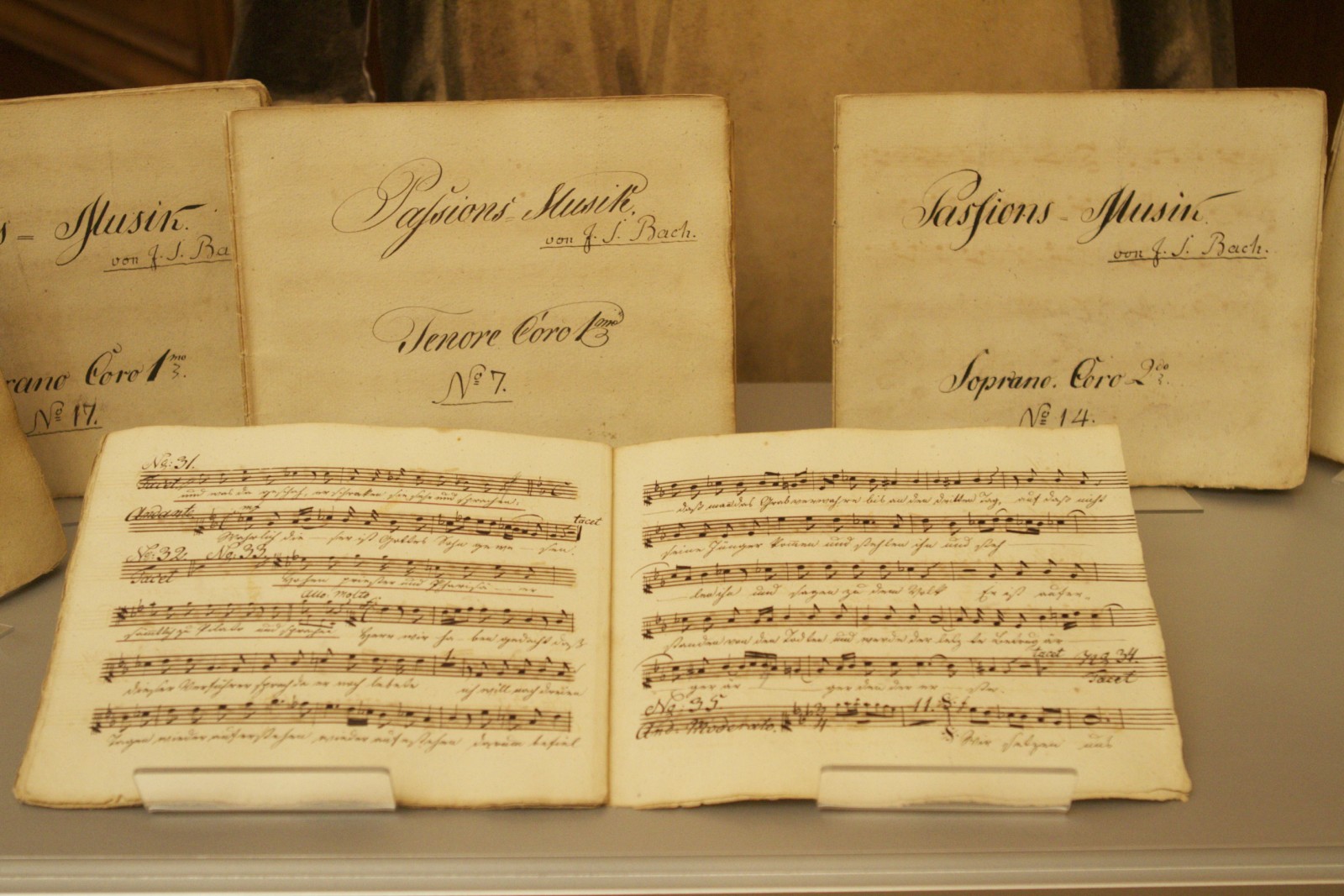
the Biblical narrative. It seems that, in Bach’s own performances, chorus members stepped forward and sang these texts, whereas the words of Peter, Judas, and, perhaps, some others, were sung by singers who were not “community members.” This practice has not, however, been followed since Bach’s own time; the arias are so demanding that specially trained soloists are engaged to sing them. Bach also composes “choral arias”: major movements which set contemplative poetry, sung by the combined vocal forces rather than by soloists.
The chorales, both music and texts, were very familiar to Bach’s listeners. Bach and Picander selected both melodies and verses carefully, to reflect the actions and attitudes being presented in their telling of the story-- so these movements have the dual role of providing comfort and familiarity to the listeners, and introducing yet more reinforcement for the overall themes of the Passion presentation. I have participated in Passion performances in which these movements were actually sung by the audience; but there is no evidence that Bach actually intended this. In some movements, Bach combines chorales, sung by the choir, with arias, sung by soloists—a hybrid procedure which functions on several interlocking levels in the telling of the story.
Odd to think about the words being more important than in the music, especially the music of Bach; but this seems to have been Bach’s own attitude and intent, in his liturgical works: to use music as a means for presenting essential text in the most immediate, dramatic, and comprehensible manner. A worship community could simply mount a reading of the biblical text, add a few hymns and a couple of meditations spoken by a worship leader, and be done with it. This is common practice in many Christian churches on Good Friday, even today. That Bach went so very much further, is his great gift to us.
Why did Bach compose his Passion According to St. Matthew?
The scope of Bach's contributions to the genre was, and is, exceptional, but the fact that he composed and mounted these productions is not: he was expected to organize some version of a passion reading, in his position as cantor of Leipzig.
In the Christian tradition, the “Passion” is the narrative, common to the four gospels, recounting Jesus’ suffering – physical and spiritual-- between the night of the Last Supper, and his crucifixion, the following day. The word itself is based upon the Latin noun passio: suffering; and shares this root with our word “patience.” Christians commemorate the Passion during Holy Week, which begins on Palm Sunday and ends the following Saturday at midnight. Following a tradition dating back to the 4th century, most Christian denominations read one or more narratives of the Passion during Holy Week, especially on Good Friday. In some congregations, these readings are communal, with one person reading the part of Christ, another reading the descriptive narrative, others reading various smaller characters, and either the choir or the congregation reading the parts of crowds and other bystanders. People began to intone (rather than simply speak) the Biblical Passion texts at least as early as the 8th century. This chanting of the text may have been freely interpretive in the beginning, but within two hundred years manuscripts began to specify exact notes to be sung. By the 13th century different singers performed specific characters in the narrative (as in the communal readings described above), a practice which became fairly universal by the 15th century, when polyphonic settings of the crowd scenes began to appear, also. By the 16th century, Passion settings had evolved into a highly developed genre, with a number of different sub-genres, composed by the prominent composers of the time. Martin Luther disapproved of the entire genre, writing, “The Passion of Christ should not be acted out in words and pretense, but in real life.” Nonetheless, sung Passion performances were common in Lutheran churches right from the beginning of the Reformation period (1517), in both Latin and German, and by the 17th century had evolved into the “oratorio passion” sub-genre, heavily influenced by the development of opera, which included instrumental accompaniment, interpolated texts, other Scripture passages, Latin motets, chorales, arias, and recitatives.
J.S. Bach’s St. Matthew and St. John Passions are the best known of this latter type. The incredible scope of his contributions to the genre was, and is, exceptional, but the fact that he composed and mounted these productions is not: certainly he was expected to organize some version of a passion reading, in his position as cantor of Leipzig. The form continued to be very popular in Germany throughout the 18th century—Bach’s son, Carl Philipp Emanuel Bach, composed over twenty settings. Interest in Passion composition waned during the 19th century, but took on new life in the 20th, with major settings by Krzysztof Penderecki, Arvo Pärt, Tan Dun, Osvaldo Golijov, Mark Alburger, and Scott King. Andrew Lloyd Webber’s Jesus Christ Superstar and Stephen Schwartz’s Godspell contain elements of the traditional passion accounts, as well.
Oratorio’s close relative, opera, perhaps the major formal contribution of the baroque period, was well known in Lutheran Germany. Handel and Telemann, Bach’s contemporaries, were celebrated opera composers, and many German courts and cities had opera houses. The Leipzig town council, in hiring Bach, made their feelings about this modern form clear: he was instructed to “produce such compositions as are not theatrical in nature.” He was not to compose operas, and his music for divine service was not to bear any trace of operatic influence. Opera had briefly appeared in Leipzig shortly before Bach’s arrival, and the city’s response to it had ranged from skepticism to open hostility. It is clear that Bach understood the possibilities inherent in operatic styles and procedures, and that his church music compositions, especially his cantatas, had already begun to absorb characteristics of this art form; it is also clear that in composing his St. John Passion, first presented only ten months after his arrival in town, he chose to disregard the instructions he had been given, and to produce a powerfully dramatic work. Rather than just recite the words of the narrator and characters, he imbued their music with profound expressiveness, in effect creating an imaginary stage for his listeners on which the story unfolds. His later St. Matthew Passion, in which the Biblical narrative is interrupted frequently with lyrical, contemplative passages, seems to be a response to criticism from his employers that his St. John was too operatic and theatrical.
Hearing Bach's Passions
Every year, there are thousands of performances of this work. Musicians and listeners, alike, keep it alive, in expensive, imaginative, carefully researched and rehearsed presentations—and it shows no signs of wear, no signs of diminished impact or declining reputation.
Daniel Melamed begins his 2005 book, Hearing Bach’s Passions, by paraphrasing Helmuth Rilling, “who reportedly once said that it was all very well that we have original instruments and original performance practices but unfortunate that we have no original listeners.” Melamed goes on to ask, “Is it ever possible for us to hear a centuries-old piece of music as it was heard when it was composed? To put it another way, when we listen to a Bach passion, is it really the same piece Bach wrote in the early eighteenth century?” He then explores and describes the religious, social, musical facts on the ground in Leipzig and the rest of the Lutheran, German-speaking world during Bach’s time, effectively making his case that Bach’s “Great” Passion According to St. Matthew, in its original context, nearly 300 years ago, is indeed not at all the work we hear in concerts today, and that no amount of care for “authenticity” in our preparations for such a performance can change that fact. Bach’s listeners were intimately familiar with much of what they heard in the Passion’s three hours of music. The wealth of hymn tunes (and texts) which serve as the musical and theological foundation of the work, also served as the foundation of German Lutheran religious practice; almost surely, every person in attendance on Good Friday knew each note and word, by heart, and felt “at home” and comfortable when these hymns were sung. Bach’s musical language, though somewhat more complex and difficult than that of his contemporaries, did not come as a bewildering surprise to his parishioners—they experienced it every Sunday, year in and year out, in the cantatas he regularly presented during weekly worship. His performers played, and sang, on instruments, and in a style, which were the everyday norm; no one had to accept sounds or expressions which were outside their normal experience. Though the words of the Evangelist and the chorales were in a somewhat archaic German, it was still a German which the listeners understood; and the arias were settings of contemporary German poetry. All of the listeners were officially and legally Lutheran, and subscribed to the theology Bach presented; I suspect they participated in annual presentations of the Passion narrative worshipfully and unquestioningly. Twenty-first century listeners might find the work’s length daunting, but this was nothing to his original hearers: they also sat through a two hour sermon inserted between parts one and two, plus a number of motets and prayers, and endured all of this in an unheated church.
Modern audiences, on the other hand, approach these inescapable aspects of Bach’s work from a tremendous distance, and would seemingly face an impossible task in overcoming this distance; to properly appreciate Bach’s accomplishment, one would think, they would need to take on a special, informed persona, an impossible task. Altogether, our current experience of Bach’s Matthew Passion is, as Melamed and Rilling suggest, irrevocably removed from the experience of Bach’s original listeners.
So why present it?
Well, the fact is, we do. People want to hear it. Every year, throughout the world, there are thousands of performances of this work-- and these performances are far more than dutiful recitations of a hoary museum piece of which we are all told to be in awe. Musicians and listeners, alike, keep it alive, year after year, in expensive, imaginative, carefully researched and rehearsed presentations—and it shows no signs of wear, no signs of diminished impact or declining reputation. Despite changing musical tastes, religious constructs, linguistic traditions, technological developments, performance styles—aspects of our material and intellectual culture which come and go with increasing rapidity-- Bach’s Great Passion shines like a beacon over all, strikes fire in some universal human heart, touches and releases some universal soul.
Chicago Chorale’s production will reflect our own “realities on the ground”: the membership of our ensemble, our performance venue, the soloists and instrumentalists available to us, the amount of money we have to spend on our production, the expectations we have of our audience. On the most basic, material level, it will be Chorale’s take on Bach’s Great Passion, not Leipzig’s. But I am confident that the core value of the work will shine through for us and for our audience, as it did for Bach and his listeners. This music is that big.
Onward and upward
Every musician I know, who has lived with Bach's Matthew Passion, has in some respect been broken, shattered, and remade through the experience.
I fervently wish a happy new year for all of us, an increase in joy and prosperity, a lessening of pain, sorrow, and hardship. Here’s hoping that the coming year brings with it the compassion, the expanded understanding, the mercy, joy, and peace, about which we sing in so much of our music. Next Wednesday, Chicago Chorale begins rehearsing J.S. Bach’s Passion According to St. Matthew, which we will present on Sunday, March 29, at Rockefeller Memorial Chapel. This work is not new to Chorale: we performed it in March, 2008, at Chicago’s Church of the Holy Family; and I have sung it, personally, on several occasions. But it will be new to many of our singers and instrumentalists; and, effectively, it is new each time one performs it-- a piece so large, so rich and multi-faceted, yields new secrets, new complications, new insights, each time one approaches it. The sheer size and scope of it guarantees that any production of it will challenge us and require our utmost concentration and commitment.
I last sang in a production of the Matthew Passion six years ago, just months after conducting it myself, at the Oregon Bach Festival, under the leadership of Helmuth Rilling. Mr. Rilling knows the work, as scholar and as performer, as well as anyone on the planet; he has written and lectured extensively on it, and has conducted it hundreds of time, which he does entirely from memory—an incredible feat. In this particular performance, we had nearly reached the end, when his memory and concentration slipped, and he miscued the tenor singing the Evangelist role, and the continuo players supporting him. It was a small thing, almost surely unnoticed by the audience; to the Evangelist and the continuo players, however, as well as to the rest of us on stage who were following in our scores, it seemed enormous; after nearly three hours of the most intense concentration and involvement, we were living every note, every word, every gesture, along with Mr. Rilling. It felt as though he, and the rest of us, had approached the holy of holies, and had stumbled at the last moment, on the top step. After the applause and curtain calls, he retreated to his favorite place, outside the stage door, and lit up his accustomed cigar; it was clear he did not want to be approached by anyone except his family and closest friends. I walked by, keeping my distance, when he called out to me—“You—you know the mountains and valleys of this piece.” That was all. I was embarrassed; I thanked him for enabling me, and us, to be owned once again by this incredible work, then moved out of range.
This experience illustrates, for me, the essential, terrifying, humbling truth about this work: Bach’s Matthew Passion is indeed the holy of holies, the most comprehensive and influential single work of musical and dramatic art, reaching past the Western musical canon and the particulars of the Christian faith to describe, through music of unbearable beauty and power, the essentially tragic nature of our human condition. None of us can know it, can encompass it, can claim it as our exclusive property, can in any respect conquer it. Every musician I know, who has lived with this work, has in some respect been broken, shattered, and remade through the experience. Its mountains and valleys are the human condition, the life we lead on this earth. How this incredible vision, in all its complexity, can have been transmitted to us through the medium of the Cantor of Leipzig, has been the subject of countless books, articles, sermons, lectures, pronouncements; Bach’s legacy, indeed, “boggles the mind.” Chorale will endeavor, over the coming months, to come to an informed grip on both this legacy, and on the music which inspires it. I hope you will join us—both in exploring this legacy, and in experiencing our performance, on March 29.
Solemn Vespers for the Third Sunday in Advent—on Saturday!
The monastery’s beautiful chapel is an acoustic gem—one of the really sublime spaces to hear choral music in the city.
 Almost since our founding, back in 2001, Chicago Chorale has sung in various liturgies and concerts at Monastery of the Holy Cross, at the corner of 31st Street and Aberdeen, in Chicago’s Bridgeport neighborhood. The monastery’s beautiful chapel is an acoustic gem—one of the really sublime spaces to hear choral music in the city. The Benedictine monks who live there, take full advantage of this beauty, chanting appropriate psalms and liturgies several times a day, day in, day out, throughout the church year. Their prior, Father Peter, was, in a former life, a University of Chicago undergrad, who majored in music and participated fully in the musical opportunities the University had to offer; and he has carried his love of good music, his erudition in selecting and performing it, and his skill in teaching others to perform it, into his life in the Monastery.
Some years ago, Father Peter and I settled upon a model for a choral advent service, very different from most such services in the city. Completely eschewing the warm, somewhat sentimental approach of most such services (which tend to focus more on the actual Christmas event, the birth of Jesus, rather than upon the period leading up to the birth), Father Peter strictly follows the texts and rubrics for the season, acknowledging the historical character of Advent as “a little Lent”—a time for reflection and self-examination, for acknowledgment of our darkness and of our yearning for enlightenment and salvation. He adapts the Solemn Vespers liturgy to the season, retaining the elements that are part of every Vespers service, every day—the Magnificat, the Pater noster, the chanting of psalms-- and then enriches this framework with the addition of polyphonic settings of such hymns as Alma Redemptoris Mater and Conditor alme siderum, and appropriate motets ( this year, Ecce Domins veniet).
The monastery’s chapel is particularly suited to polyphonic, unaccompanied music, performed by a smaller group of light, clear voices—so each year I choose a subset of Chorale’s singers who are particularly adept at this repertoire, and enthusiastic about the disciplines that go into performing it. Father Peter is interested in the historic background of Roman Catholic music, and in experiencing it in its appropriate role as liturgical, rather than concert, music. Each year, we explore the liturgical music of a particular composer—music one would usually hear in concerts by groups which specialize in renaissance music, but less and less in actual liturgical practice. This year’s composer, Tomás Luis de Victoria, was the most famous composer in 16th-century Spain, and one of the most important composers of his era. He studied in Rome with Palestrina; but his music has a brooding, emotional quality very different from that of his teacher, and appeals viscerally to modern listeners in a way Palestrina’s sometimes doesn’t. Many singers claim Victoria as their favorite renaissance composer: not only does he write beautiful lines which combine in beautiful harmonies, but he appeals to the heart and the feelings.
If you are free at 5 PM this Saturday afternoon, December 13, come and experience this beautiful service in this beautiful space. We request a donation of $15, but are happy for anything you can give; mostly, we want to you come and hear us, to step into a world of peace, quiet, and stillness and let all the elements of this Vespers service have their way with you.
Saturday, December 13, 5 PM, Monastery of the Holy Cross, 3111 South Aberdeen Street.
Mozart wrap up
Chorale’s rousing success with Mozart’s Mass in C minor says many things about our group.
Chorale’s rousing success with Mozart’s Mass in C minor says many things about our group. First: our unwavering faith in our ability to handle the finest music available to us, though it seems at times preposterous, actually enables us to rise to the occasion, accomplish the musical and linguistic requirements presented by the task before us, at a level few of us would be able to accomplish on our own. We have learned, over the years, that organized hard work toward a worthy goal is a powerful motivator. Chorale’s singers start out expecting, even demanding, the right to learn and present great music; but that can be a pretty nebulous goal, until put to the test. Our singers tend not to waver and fold when truth smacks them in the face; rather, they are energized by the demands of the task before them, and expand, joyfully, to fill whatever shoes need filling. This is simply the character of the singers who constitute our ensemble; every conductor should be as lucky as I am, to have such personalities in his choir.
Second: there really is an audience out there, for the sort of music Chorale chooses to present. Chicago is a big city, and the task of contacting, and attracting, those who love great music, can be daunting; but the size, and palpable enthusiasm, of the audience who heard us in Orchestra Hall—the place was packed!-- convinces us that we are on to something, in our repertoire focus. These people love Mozart. It is so important to me, and to the group, to know that we are on the right track, in programming such repertoire. Chorale has to learn better how to market ourselves, in order to get these same music lovers to come again and again to hear us; but we have now seen about 2,500 of them, we know they are out there, and they have heard us.
Third: our demanding, never-ending search for appropriate collaborators pays off. We thoroughly enjoyed working with Civic Orchestra of Chicago, and felt pushed by their standard, to raise our own; and in Nicholas Kraemer we found a conductor who could really appreciate our musical values and ideals, guide us in making sense of the music on the page, and help us put it all together in a finished performance. His musical ideas, honed by many years of working with first class chamber and period ensembles, both as player and as conductor, matched very well with Chorale’s disciplines and goals; effectively, he spoke a language we had already studied, and he hastened our learning. We were never confused by him; he wanted what we wanted, and he taught us to want it at a higher level.
Finally: we had so much fun! Doing great music to the best of our ability is fun. The tension and stress of getting to that level, though palpable in rehearsals, melts away once we get in front of an audience. The greater the challenge, the higher the level of our performance, surely; but also, the higher the level of our enjoyment! Doing great music well, is a sublime joy.
Iron fist in a velvet glove
Our Mozart Mass in C minor now belongs to Nicholas Kraemer. Please come and hear what he does with it!
Chorale’s first rehearsal with Nicholas Kraemer was very exhilarating and exciting. The singers were prepared, and on their best behavior: they arrived on time, they uncrossed their legs and sat up straight, they watched the conductor, they shone with enthusiasm. This must have been very gratifying for Mr. Kraemer—he had just arrived from London, and announced his jet lag, apologizing in advance for any shortness of temper he might display (there was none). Throughout the afternoon, watching and listening to Mr. Kraemer rehearse, I repeatedly thought of a phrase I first heard in a master class with soprano Elly Ameling and pianist Dalton Baldwin, more than thirty years ago: “iron fist in a velvet glove.” Referring specifically to a song by Gabriel Fauré, Ms. Ameling warned a singer not to give into his feelings, to his romantic impulses, but to submit them to the rule of the tempo, the pulse. She told us that the truth of Fauré’s musical language lies in the tension between these two poles: the unwavering firmness of his forward movement, and the emotion expressed through his harmonies and melodies.
I often use this phrase, and principle, when rehearsing Chorale. We all feel the beauty and emotional satisfaction inherent in the music we perform; but we can’t afford to skip, or even skimp on, establishing what I call “the grid”: the pitches, up and down, and the rhythms, from here to there. Chorale members spend an amazing amount of time nailing down pitches and rhythms, both on their own time and in group rehearsal. I do my best to let nothing slide, to correct every error, to clarify each rhythmic subdivision—I always imagine some bright music student taking dictation, and try to produce something he can hear and transcribe. I remember very well a phrase Harry Keuper used in describing Robert Shaw’s nagging perfectionism: “toilet trained at the point of a gun;” and I wonder if my singers say something similar, of me.
To some extent, I have become this way out of a desire to overcome my own unbridled feelings and impulses when enjoying music. Elly Ameling was speaking to me; and years of studying and performing with Dalton Baldwin, Robert Shaw, and Helmuth Rilling have developed a hyper-awareness in me of the many ways there are to indulge oneself and get off track. But I also realize on my own, that when a large group of singers gets together, they can very easily become an amoeba, spreading formlessly all over the place and leaving structure and coherence behind, no matter how much they love what they are doing, no matter how good they feel about themselves. Yet I am on guard that I not suppress the wit, style, and life of the music-- the velvet glove-- in order to keep the amoeba corralled. Fauré’s music needs work with a metronome; it also needs acknowledgement and nurturing of its silk and velvet soul.
As does Mozart's. Just a couple of weeks ago, I said to Chorale, “I am trying hard to balance the iron fist with the velvet glove, trying to make the most efficient choices, in preparing you for what Mr. Kraemer will bring to this performance.” And when push came to shove, I chose the fist. The grid. During our conductor’s piano rehearsal, I witnessed Mr. Kraemer slide his velvet glove onto the fist I had prepared, listened to him smooth the rougher edges, sand down the sharper articulations, enliven the gnarlier passages over which we had slaved in establishing clarity—and I was envious. I wanted to enjoy, myself, breathing life and style into this music, stroking its velvet surface. So much like losing control of your child as she goes off into the world, hoping you have chosen to emphasize the right lessons, established the iron fist within but at least hinted at the promise, the beauty, of that velvet glove.
Our Mozart Mass in C minor now belongs to Nicholas Kraemer. Please come and hear what he does with it!
Mozart's Unfinished Mass
Two important questions hang over any consideration of Mozart’s Mass in C minor: how did it come to have so huge a design—so very different from his other masses; and why didn’t he finish it?
Two important questions hang over any consideration of Mozart’s Mass in C minor: how did it come to have so huge a design—so very different from his other masses; and why didn’t he finish it? Prior to 1781, Mozart had been court organist and concertmaster, assisting his father Leopold, who served as deputy Kapellmeister for the Prince-Archbishop of Salzburg, Hieronymous Colloredo. In this capacity, Mozart composed a number of settings of the mass for liturgical performance at the Salzburg Cathedral. The Austro-Hungarian Emperor Joseph II sought to reform the Catholic mass service, and called for sacred music with short and relatively unadorned choral passages, no aria-like solos, and no choral fugues. Colloredo followed the emperor’s lead, requiring that a mass not exceed forty-five minutes in length; as a result, Mozart's mass settings for Salzburg are relatively short, and most are not awfully interesting. For this and many other reasons, Mozart felt exploited and imprisoned, and sought every opportunity to leave Salzburg. Finally, in May of 1781, he left the archbishop’s service and moved permanently to Vienna, embarking on a career as a freelance composer. His rejection of the secure life of Kapellmeister chosen for him by his father, together with his courtship of the young soprano Constanze Weber, of whom his father disapproved, caused a rift between father and son which was never really healed; when Wolfgang and Constanze were married, in August 1782, it was without Leopold’s presence or blessing.
Shortly after Mozart's arrival in Vienna in 1781, he met Baron Gottfried van Swieten, a patron of the arts who actively promoted the music of past masters such as Handel and J.S. Bach. He owned a copy of the complete score of Bach's Mass in B minor, probably obtained from Bach's son Carl Philip Emmanuel. It is suggested that Mozart composed his Mass in C minor in reaction to his exposure to this work, and to Bach and Handel in general. He adopts the Italian, “cantata-style” structure of Bach’s Mass, dividing the texts of the five mass sections into smaller movements, each of which stands on its own, as opposed to the "through-composed" style where the entire text is sung from start to finish, without a break. Movements often alternate between elaborate contrapuntal choral settings and operatic arias for one or more soloists. The style was more operatic and theatrical than that allowed by the Emperor and the Prince-Archbishop, and resulted in a far longer mass than was allowed. Mozart imitates Handel's dotted, French overture rhythms (the signal in Baroque France for the arrival of the king) in texts addressing the King of Kings. Mozart's Mass in C minor and Bach's Mass in B minor both have an impractical combination of choral voicings, with five-part choir for modern-style choral writing, four-part choir for fugal movements, and double choir for the Osanna The orchestral layout is similarly impractical, each work containing a solo instrument that sits quietly for an hour before accompanying a single aria. Mozart's setting has a number of movements where the bass section descends, half step by half step, over the distance of a fourth, as does the Credo movement in Bach’s Mass. And the fugues are among Mozart's first efforts to compose counterpoint with anything like Bachian complexity. In discovering and reacting to Bach and Handel, Mozart adopts the grandness of their conception, leaving behind forever the relative modesty and self-effacement previously forced upon him by circumstances in Salzburg.
There is no evidence that Mozart received a commission to compose his Mass, and it is not clear why he decided to do so. He mentions the work once in a letter to his father, in which he promises a mass if he can bring his wife Constanze home to Salzburg to meet her husband’s family. It has been suggested that this Mass may have been intended as a peace offering to Mozart’s father, as an act of thanksgiving for the birth of his first child, and as an opportunity to show off his wife’s talent (she sang one of the soprano solos at the work's one and only performance). Constanze herself recalled that he promised to write a mass after her recovery from the birth of their first child.
Wolfgang and Constanze arrived in Salzburg at the end of July, 1783, with only half of the work completed: the Kyrie and Gloria movements. Once in Salzburg, he worked on the first half of the Credo and the Sanctus. Some movements are not complete in copies that have come down to us, but a number of scholars have reconstructed them. Mozart never composed music for the second half of the Credo or any of the Agnus Dei. The Mass in C minor was performed in St. Peter’s Benedictine Abbey, just outside of Salzburg (and marginally outside the jurisdiction of the Prince-Archbishop) on Sunday, October 26, 1783, in a liturgical setting; presumably the missing movements were replaced with movements from Mozart’s earlier masses, or with plainchant.
And that was the end. Mozart never returned to his Mass, except to adapt some of its music for another work, Davide Penitente, in later years. Like Bach’s Mass in B minor, which preceded it, and Beethoven’s Missa Solemnis, which followed it, the Mass in C minor would, if completed, have been far too long for practical liturgical use; one has to assume that Mozart was too busy and pressed to devote time to completing a work which stood little chance of being performed. Unlike the other two composers, Mozart became more and more committed to opera, which took up much of his time and attention for the remaining years of his career.
Great music, done well-- by and for whom?
Last night‘s Mass in C minor rehearsal was absolutely thrilling for me-- Chorale’s singers get it, and I know our audience will get it, too, when they hear our November 24 concert.
When Chicago Chorale first sang together, in October 2001, all of its members were University of Chicago students or alums. And I am fairly certain that the audiences who first heard us were composed entirely of Hyde Parkers, most with U of C connections. Though we continue to rehearse in Hyde Park, U of C’s home turf, the actual percentage of those with University affiliation has slipped since then; currently, about sixty percent have some formal connection with U of C. And we now present at least half of our concerts outside of Hyde Park, attracting a regional, rather than purely local, audience. But I think Chorale’s style, habits, expectations, continue to reflect its roots. From the beginning, our singers have tended to be highly intelligent and educated; they have experience with a broad range of musical styles, and prefer the rigorous, erudite programming which has become our trademark; they attend concerts, listen to recordings, read reviews and scholarship, and are generally very informed, about music and about arts culture in general. They read extensively, write well, think critically, and question nearly everything. Not a week goes by, that I am not stopped after rehearsal, or do not receive at least one email, with a comment, suggestion, question, clarification, about something I have said or done during rehearsal. The singers pay close attention to my verbal communications, oral and written, and on occasion correct me, pick at my grammar, argue with me. I am continually reminded that they really listen to me, that I must be careful, be on top of things, mean what I say, have supporting information, avoid platitudes and generalities. And I often need a thicker skin to face their probing, informed questions and remarks, than l expect.
Chorale singers expect to perform on a high level. They are in general confident, disciplined, and determined to succeed. They demonstrate little fear or hesitation when tackling really challenging repertoire—rather, they revel in being challenged. Their general, incoming level of vocalism and music-making is respectable and competitive; what sets them, and Chorale, apart, thought, is the richness of understanding and experience with which they approach their craft, and the high level of appreciation they experience in practicing it. It is the general character of choral performance, that the sum is greater than the parts; with Chorale, this characteristic takes on new and urgent meaning. Altogether, Chorale is a very different group than I have ever sung with or conducted in other places, at other times. New singers are either drawn specifically to this character of the group, or they learn to appreciate and value it.
Many in our audience have had experiences and expectations matching those of the choir. Like the singers, the listeners started out as U of Chicago/Hyde Park types, and this local support and appreciation were organic in shaping our direction and mission; now, though, we draw music lovers from all over greater Chicago. Chance remarks and comments—“Oh, I so look forward to hearing your take on Rautavaara!” or “Your tempo on the Bach motet was somewhat faster than I expected” or “I thought your Nystedt had an appropriately northern flavor” always let me know that our listeners, like our singers, really pay attention, think, prepare, and understand what we are doing.
A growing segment of our audience, though, does not have specific musical background, and is drawn to our concerts by the “buzz,” or by their friends; and these listeners, hearing a kind of programming very new to them, seem inspired by it-- they find authenticity in what we do, and respond out of their best selves to the best that the composers, and the performers, can offer them. I deeply believe that great music, done well, reaches across cultural and socio-economic divides, and gets right to the middle of things. Mozart is not a cultural hero because our betters tell us he is, nor because a blockbuster movie was made about him; his position in our musical firmament reflects fundamental values that our singers, and our audience, sense and understand. Last night‘s Mass in C minor rehearsal was absolutely thrilling for me-- Chorale’s singers get it, and I know our audience will get it, too, when they hear our November 24 concert.
Rehearsing this Mozart concert efficiently
We are in the midst of a “three rehearsals for the price of two” period, using it to crack open the larger, more complex movements of the Mozart Mass in C minor—Cum sancto spiritu, Credo, and Osanna—at the breakneck tempos Maestro Kraemer has requested of us.
Americans, at least, have a pervasive choral rehearsal model: one night a week, 2-3 hours, maybe an extra rehearsal or two before a concert. Perhaps this started with church choirs, which are responsible for weekly performances; but it is a pattern most choirs follow. When I first began singing in Chicago, I had one night for Symphony Chorus, one for temple/JCC, one for church, one for Collegium, one for Grant Park, one for Chicago Opera Theater Chorus (not all during the same time period!)—and so it went. It kept me sharp vocally, and taught me to learn quickly, reinforced my flexibility. I was a professional, this was my job, and I had to make it work. Over the years, though, I began to question the wisdom of this model, especially for those singers who don’t aspire to be professionals, who sing in only one ensemble (and therefore one night a week). How efficient is it, to rehearse once a week? What percentage of what is taught and experienced on one Wednesday night, is lost during the ensuing week, and has to be relearned? Especially after I began singing in summer festival situations, with Robert Shaw and Helmuth Rilling, where singers are expected to sing six hours per day, six or seven days a week, over a short period of time, I began to question the effective use of rehearsal time. The latter, festival model, is incredibly efficient—singers and ensemble have no chance to forget anything from one rehearsal to the next, no chance to become complacent and stale, to let brains and voices become slack; they pick up right where they left off at the previous rehearsal, always moving toward the performance. Not only do they learn more quickly, I believe they enjoy it more, too: less repetition, less empty time listening to other sections drill, and, not surprisingly, more social interaction-- they see a lot of one another, both during breaks and after rehearsal, and constantly reinforce the “ensemble” aspect of what they are doing, feeding both interpersonal and musical needs. I have noticed this model being adopted more and more during the “non-festival” time of year, as well-- young professional singers are hired for an intense two-week period, prepare a concert and/or recording, give their all, then go home when it is done. These performances and recordings tend to be very high quality, though expensive to manage; and the singers appear to be the best of friends.
This latter model also resembles the pattern I experienced in college choir—five rehearsals a week of an hour and twenty minutes each, then a couple of weeks of intense, six-hour days before the choir left on tour. The more I thought about it, and realized that most college choral programs had nothing so intense as what I had undergone, the more clearly I understood that the excellence of my college choir was largely based upon the intensity of this rehearsal experience. Anything was a letdown after that—though it took me several years to understand why.
Chorale began, back in 2001, with the typical, one night a week pattern. Gradually, as our repertoire and season became more demanding, I added rehearsals—by adding weeks. Over time, I have come to feel this is not the best and most efficient way to do things, and have, in fact, shortened our actual rehearsal season, while keeping the same number of rehearsals—by adding Saturday rehearsals. I figure we will actually have better results, this way, than we would with the older, more traditional model. Usually we begin rehearsing the beginning of September; this year our first rehearsal was September 27. We will take six weeks off over Christmas, rather than three. The missing weeks are accounted for by Saturday rehearsals. Will I/we get away with this? Will the added time on weekends prove onerous to the singers? Really, I am attempting to move the definition of “amateur” closer and closer to “professional,” and it is new territory for us. Time will tell; the singers themselves will decide with their feet, whether this is to work or not.
In the meantime: we are in the midst of a “three rehearsals for the price of two” period, using it to crack open the larger, more complex movements of the Mozart Mass in C minor—Cum sancto spiritu, Credo, and Osanna—at the breakneck tempos Maestro Kraemer has requested of us. So much glorious music, coming at us so fast! The exhilaration of learning this stuff is mind-boggling. Great Music, Done Well.
Great music, done well
Chorale’s happy task is to live up to the standard set by our partners-- what an inspiring challenge!
My shorthand version of Chorale’s mission statement is, “Great music, done well.” That’s why the group was founded: to give local singers who had a high level of expectation on both fronts, an opportunity to live out those expectations in real time. Such a mission can be a tough sell: good performances cost money; and why should anyone but our closest friends be interested in hearing us live out our expectations? Chorale struggles with this puzzle all the time. I constantly remind myself, and those with whom I work, to remember this mission, to believe in it, to keep it fresh, to forge ahead with it, to take great risks in keeping it alive. I personally would become bored and disheartened if Chorale ever lost this; I believe many of our members, and the core of our audience, would react similarly. Commerce is important; mission is why we exist at all. So I am thrilled with our current preparation, Mozart’s Mass in C minor, which we will perform with the Civic Orchestra of Chicago, under the baton of Nicholas Kraemer, at Orchestra Hall, November 24. All demands of the mission are satisfied: great composer, great work, wonderful orchestra, noted conductor. Chorale’s happy task is to live up to the standard set by our partners-- what an inspiring challenge!
I have sung in numerous performances of this work in the past, in three different versions (Mozart left the work unfinished, and various scholars have either “completed,” or tidied up, what Mozart left, producing editions for public performance, all of them differing in details). I have been thrilled by the music, and have wanted to perform it with Chorale—but the cost of the orchestra, especially given Mozart’s extensive use of winds, is simply beyond Chorale’s means. I expected never to perform it, until this opportunity with Civic came up. In character, this Mass is very unlike the smaller masses with which Mozart preceded it: the brilliant orchestration, the virtuosic solo writing for soprano (composed specifically for Mozart’s wife, Constanze, and her sister), the varied, richly-textured choral writing (the fragment includes movements for four and five parts, two movements for double chorus, and a major fugue), and the pervasive emotional expressiveness, unusual during that period, far exceed the writing in his other masses. Clearly, this work was very important to Mozart at the time he was composing it, and he poured a good deal more of himself into it than was considered necessary in a liturgical mass.
I met with Maestro Kraemer this week, and we discussed various aspects of the work, along with his ideas and preferences. One thing he said, which really sticks with me: this is not a tragic work. Yes, it is grand, and reaches very far; Mozart had discovered J.S. Bach, and knew of the B Minor Mass, by this time, and clearly was inspired to compose a work which in its own way would be as transcendent as Bach’s. But he was young, hopeful, recently married, striking out on a successful career; he was not weighed down with debt, illness, fear of death, as he was when he composed his Requiem. Maestro Kramer was particularly concerned that the Kyrie movement not be too slow and ponderous; and he insisted that each movement, no matter the tempo, be clear, light, and dance-like.
Chorale is working hard to perform the in the style, and at the level, Maestro Kraemer expects. I am confident that all aspects of the performance will contribute to the growth of our technique, to our understanding of the style and genre, to our appreciation of the composer and a new understanding of the esteem in which he has been held ever since his own lifetime; and I expect the audience will be thrilled and changed, to share so deeply in this experience. Beyond that—I know this will be a wonderful concert, as much a treat for the listeners, as it will be for the musicians participating in it.
Free tickets are available through the Symphony Center box office; don’t miss this opportunity, to experience this wonderful music!
It's the repertoire
Take the time to find what you love, and work on that; don’t waste energy on pieces to which you are not committed. You will lose interest; and your choir, and your audience, will sense your lack of engagement.
I distinctly remember that my college choral conductor, Weston Noble, had a couple of four-drawer file cabinets in his otherwise comfortable, uncluttered office-- cabinets that had nothing to do with his secretary, or with the daily operation of the music department. The drawers were always closed, and were not labeled. One time, he asked me to retrieve something from one of them-- and I discovered the rich and mysterious world of Weston’s single copies collection. All of the drawers were stuffed with choral music; many of the pieces had notes written on them, notes paper-clipped to them; many were gathered in manila folders; many looked unused. I asked, in awe, have you conducted all of this music? No, he laughed, not even a tenth of it. He had gotten it from publishers, from composers, from conducting colleagues, from former students, from reading sessions. He also had a piano in his office, and would play through pieces at night, make notes, file some in folders labeled “openers,” “closers,” “light,” “next year,” “All-State” etc. He told me that his first priority as a conductor was selecting his choir, but that a close second was choosing appropriate repertoire. Any conductor accumulates a similar collection. Mine is enormous. The fact that I sang as a professional chorister for so many years, means that I not only have collected single copies, but also that I know a lot of music which I do not personally own. And like Weston, I periodically dig through my collection, as well as through my memories and my recordings, to find just the right piece for this or that. Sometimes, I explore my collection just for the joy of it, discovering pieces I did not even know I had. I am not so painstaking and organized as he was—I have stacks all over the place, unlabeled folders, single pieces lying on shelves and gathering dust but which I am loath to file, for fear I lose track of them.
I think the most important thing Weston told me, relative to his collection, was that there are millions of pieces of music out there, and one will never do all of them. Take the time to find what you love, and work on that; don’t waste energy on pieces to which you are not committed. You will lose interest; and your choir, and your audience, will sense your lack of engagement. Sure, a younger, less experienced conductor has to experiment, has to explore many possibilities, some of which turn out badly. I thank the many years I spent conducting a high-level church choir with a good library, for giving me the opportunity to try out hundreds of pieces; that, combined with my singing, gave me a wonderful opportunity to develop my own taste, to discover my musical passions, to explore style and technique in a concrete way.
I work no less hard now, than I did thirty years ago, choosing repertoire for a concert season. I wallow in possibilities, listen to recordings, awaken my family by playing through music late at night—and I go to my single copies collection, to find just the right piece to go where it is needed. Chicago Chorale’s 2014-15 season is in some ways easy, a slam dunk: Mozart’s ’Great’ Mass in C minor and Bach’s St. Matthew Passion both sit at the very top of the “great music” mountain, and both are personal favorites of mine. Our spring concert, though, will consist of a number of smaller works, focusing on the theme Da pacem Domine—Give peace, Lord-- works which must satisfy my personal taste, must complement one another within the larger structure of the program, must contribute to an overarching theme without bludgeoning the listener with it; works which must satisfy, even thrill, as individual statements, while forming a satisfying, uplifting, entertaining whole.
Chorale has now rehearsed twice this fall, and I am getting a feel for the sound and character of this particular group of singers. I’ll soon be able to choose appropriate repertoire for the spring, and the prospect really excites me.
Chorale Retreat
A choir that enjoys brats, beer, and Frisbee together, has an irreplaceable advantage, over one that does not.
Each fall, at about this time, Chorale meets at a site other than our regular rehearsal venue, and spends an entire day, placing voices, reviewing our past, digging into our new repertoire, getting to know our new members, and leaving most of the outside world behind. This year is no exception. We will meet this Saturday, September 27, at Ellis Avenue Church, and kick off our new season with a total immersion experience, from donuts and coffee to brats and beer. Chorale’s members live all over the Chicago region, from St. Charles to Northern Indiana, from Evanston to Crete. Some of them drive as much as two hours through rush hour traffic, every Wednesday, to get to rehearsals; they arrive just as the singing starts, and drive home as soon as it is over, and haven’t a lot of time, before and after rehearsal, to socialize with other members. And, because we tend to rehearse only once a week, it can be difficult for singers to remain fresh and engaged with the repertoire, and with Chorale’s approach to singing it. Membership could all too easily become an encapsulated blip on ones weekly radar, providing far less of the overall, exhilarating experience than we intend. Our opening retreat allows us to really roll around in our music, absorb the smell of it, and become comfortable with the people with whom we share it.
We start out drinking coffee and eating, of course. Our librarian, Erielle Bakkum, will distribute music—which, this fall, is Mozart’s Mass in C minor, ‘The Great’, which we will sing with Civic Orchestra of Chicago on November 24, at Symphony Center. We begin rehearsing, as always, with a period of vocal warm up, both because we need it, and to introduce our sound and production ideals to the new members. At this time they will meet our accompanist, Kit Bridges, whose leadership from the keyboard is so integral a part of our musicality. After warm up, we will divide into sections, and I will place the voices in each section in an order which is both most comfortable for the individual singers, and best sounding from the outside. Once placed, the choir will reconvene and begin work on the “easier” movements of the Mass, finding their sound, their balance, their “place in the choir.” After a break for lunch, Frisbee, and conversation, we will gather in the rehearsal space again, and continue rehearsing, touching on at least one of the more difficult movements (they are all difficult, whom am I trying to kid; but one with some challenging polyphony). Interspersed amongst both the morning and afternoon rehearsal periods, we will hear about “the state of the choir” from our board president, Angela Grimes, and be informed of specific details and housekeeping items by our managing director, Megan Balderston. In the meantime, Megan and a team of non-singing volunteers will take care of food, culminating in a bratwurst and beer celebration at the end of the day. By this time, many families, including children, will have arrived to join us in eating both the brats and all the other, potluck items members have provided.
Later in the Fall we will rehearse on a couple of Saturdays, as well, to help us keep our edge and forward momentum, right up to our conductor’s piano rehearsal with Nicholas Kraemer, who will take over at that point and conduct our performance with Civic.
A choir is so much more than a group of singers, each of whom turns their talent on and off at the touch of a button once a week. We are an “ensemble”—together, in so many senses. Without that togetherness, we tend to lose direction, motivation, commitment—and this loss shows up in the quality of our performances, as well as in the enthusiasm with which we sell tickets to our friends, and fill our halls. A choir that enjoys brats, beer, and Frisbee together, has an irreplaceable advantage, over one that does not.
For the Love of Singing
Wouldn’t we all have more hope for our world, knowing that our doctor, our professor, our neighbor, our lawyer, our child’s kindergarten teacher, shared our love of making great music?
Last week, I wrote, “A professional ensemble has the luxury of choosing repertoire, then hiring a choir that can sing it; my job is somewhat more complicated and challenging—and never less than interesting.” I have been thinking a lot, lately, about the divide between Chicago Chorale and the paying groups with whom we compete and share the stage, and about the broad implications of “amateurism” versus “professionalism.” Chicago Chorale is all about enriching, and transforming, the lives of its singers, as well as its audience. We seek, unapologetically, a high production standard, and high artistic achievement; and we seek to perform the very best music literature available. But we do this, not for commercial reasons, but because we are persuaded that people are changed, are moved to be better, to strive for better lives for themselves and others, through making music, themselves, the best they can do it. Yes, some music is more difficult to understand, and execute, than other music. But we believe that our collection of singers can understand, and share in, the most profound works of the greatest composers; we believe that, given sufficient rehearsal time, training, motivation, and will, we can do as well as any commercially-motivated group of professional singers—and that our end product will be special, and individual, because of the growth of understanding that we have experienced through the often difficult process of preparing it. Chorale’s performances are not only “correct”; they are also imbued with the spiritual, emotional journey each singer, and the ensemble on the whole, encounters putting them together.
I have lived on both sides of this divide. I have made a lot of money over the years, singing in performances, on recordings, sometimes with wonderful ensembles, sometimes with ensembles that aren’t so great but that paid me to help them sound better than they would otherwise. I have been grateful for my talent and skill, grateful that conductors have hired me to sing the repertoire they have chosen. I have been grateful, as well, for the company of other highly skilled singers, who have made my own job quicker and easier. I have learned so very much through such experiences. I have taken great pride, and felt considerable pleasure, in pulling off major works with minimal rehearsal and maximum pay. Finally, though, I believe that the most fundamental and valuable work is done by groups like Chorale-- groups that change lives, that transform understanding, that touch everyday people with divine fire. My experiences in school and community groups, in college choirs, were not just steps along the way, training grounds that weeded out the less gifted and brought the chosen few forward toward the truth of professionalism; they were glorious experiences that turned me inside out when they happened, that made me who I am today. Along the way, I learned that I may be selfish and neurotic much of the time, but under the influence of great music I am made better, and have the wonderful opportunity of giving the best of myself. And I learned this long before I collected my first paycheck for singing.
Wouldn’t we all have more hope for our world, knowing that our doctor, our professor, our neighbor, our lawyer, our child’s kindergarten teacher, shared our love of making great music?
Summer’s placid surface is about to explode into the frenzy of Autumn.
I entered this profession with ideals and excitement; too often, though, ideals are back-burnered, and one is compelled to think in terms of what sells, what will the ensemble tolerate, what can we afford. September-May can easily become a exercisein keeping ones head above water; June-August can be a welcome antidote to that.
Chorale has not presented its own concert since May—but the summer has not been quiet! An ensemble called Chicago Chorale (comprising Chorale members, past, present, and future, as well as other singers from the community) sang two concert preparations at Ravinia this summer: An Evening of Lerner and Loewe, and The Return of the King, which were a lot of work, a lot of fun, and made some money to help support our 2014-15 budget. And nothing else sat still, either. We are currently in the midst of moving to a new rehearsal venue (First Unitarian Church, 57th and Woodlawn), which is more complicated than one might think, since it involves moving our piano and choral library, as well as working with a new church administration, a new contract, and a new set of regulations and behaviors. We are also preparing for another European Tour (our last was in 2011)—this time we will visit the Baltic countries, during July of 2015; and while not all Chorale members are involved, more than half will participate, and the entire venture must be “administered” from within the ensemble. Tour company, repertoire, itinerary, schedule of payments—none of these take summer vacations. I chose most repertoire for the 2014-15 season long ago. Planning for our performance of Mozart’s “Great” Mass in C minor with Civic Orchestra, under the direction of Nicholas Kraemer, at Symphony Center, November 24, has been underway for more than a year. Similarly, our performance of Bach’s St. Matthew Passion, which we will present at Rockefeller Chapel on March 29, has been in the works for a long time; the soloists, and most of the instrumentalists, had already been contracted by March. We even had a detailed rehearsal schedule before the end of July. Decisions about our spring concert, Da Pacem Domine, scheduled for June 13 at St. Vincent DePaul Parish, present a different sort of challenge: a cappella repertoire choices must reflect, more closely than large, orchestrated works, the specific voices we retain from the past season, as well as the new voices we choose through auditions; and this repertoire must be adaptable to the smaller ensemble that sings it on tour, as well. I have spent a good deal of time ordering and studying scores, and listening to recordings, and have compiled a short list; but I won’t be able to make final choices until I hear and have worked with this season’s choir. A professional ensemble has the luxury of choosing repertoire, then hiring a choir that can sing it; my job is somewhat more complicated and challenging—and never less than interesting.
Summers offer an opportunity to pull back, remember my training and performance experiences, think about what I love about music, recall the repertoire and performers that have particularly moved me, and really spend time with my choices. I entered this profession with ideals and excitement, which have been sharpened by wonderful teachers and training; too often, though, in the midst of actually preparing, and paying for, concerts, ideals are back-burnered, and one is compelled to think in terms of what sells, what works, what can one get away with, what will the ensemble tolerate, what can we afford. September through May can easily become a exercise in keeping ones head above water; June through August can be an antidote to that. I listen to recordings of earlier repertoire played by today’s top period ensembles, and remember the revelatory summers I spent at Oberlin’s Baroque Performance Institute; I listen to Kiri Te Kanawa sing with her still-flawless technique and legato line, and reflect on my teachers, on how hard they worked to help me to understand, and execute, the same things; I explore the ever-growing body of new choral music, and try to decide for myself what is merely attractive, what is clever and intriguing, what will continue to excite and inspire me in the future. I listen to recordings of the incredible number of good choirs out there, compare them with the choirs I have sung in and the conductors I have worked with, and try to get past the flawless surface enabled by current recording techniques, and determine for myself if such and such a group, such and such a conductor, is doing really honest, exciting work. Some sleepless nights I spend three or four hours with YouTube, listening, watching, comparing, ordering CDs and single copies, writing emails to conducting colleagues and asking for suggestions and opinions.
Summer’s placid surface is about to explode into the frenzy of Autumn. I look forward to it!
The Liebeslieder texts: who was G. F. Daumer?
Philosopher and poet Georg Friedrich Daumer (1800-1875) was Brahms’ favorite poet; the composer set about twenty of Daumer’s poems, in addition to the thirty-two contained in the two sets of waltzes.
The title pages to both Liebeslieder Walzer Opus 52, and Neueliebeslieder Walzer, Opus 65, contain the subtitle Aus “Polydora” von Daumer. I thought it prudent to track down this reference. It turns out that philosopher and poet Georg Friedrich Daumer (1800-1875) was Brahms’ favorite poet; the composer set about twenty of Daumer’s poems, in addition to the thirty-two contained in the two sets of waltzes. I read that Daumer was particularly drawn to Persian poetry. One of his best-known collections, entitled Hafis, published in two volumes (1846 and 1852), is actually a group of very free translations and imitations of songs by the fourteenth century Persian poet Hafiz, whose rhyming couplets, many of which concern love, wine, and nature, are traditionally interpreted allegorically by Sufic Muslims. The Catholic Encyclopedia describes Daumer as “an enemy of Christianity”-- and whatever this may mean, it does seem that Brahms, an agnostic, was drawn to Daumer’s anticlericalism, as well as to the mystical, lyrical, sensual quality of his poetry.
Daumer published another collection, also in two volumes, of translations and imitations of folk poetry, based on Russian, Polish, Hungarian, Turkish, Latvian, and Sicilian sources, in 1855, entitled Polydora: ein weltpoetisches Liederbuch. In this collection, as well, Daumer is so free in his use of the source material, that one is hard-pressed to differentiate between his original work, and authentic folk poetry (if there really is such a thing). Both volumes concern themselves with the many facets of love: longing, reluctance, denial, sadness, obsession, joy, rapture. Brahms chose eighteen of these poems for the earlier Liebeslieder Walzer, Opus 52. These poems, and their settings, strike me as somewhat more positive and genial, even naive, than the fourteen he set in the second set, Opus 65. The latter set, both poetry and music, deals more directly and specifically with the difficulties of amorous human relationships. Striking chromatic harmonies, jarring rhythms, and minor keys underscore the more serious nature of this latter opus. The music seems darker and more passionate-- and it is more difficult to perform. Altogether, Opus 65 creates such tension, and potential problems for itself, that it seems Brahms can’t find anything in Daumer’s collections to tie things up and bring them to a satisfying conclusion-- so he turns, in the final song, Zum Schluß, to a verse by Johann Wolfgang von Goethe (1749-1832), perhaps Germany's greatest poet, for a peaceful, soothing end, appealing to the muses, who alone, according to both composer and poet, can calm the stormy seas of the human condition. Interestingly, and brilliantly, Brahms, in abandoning Daumer, also abandons the waltz rhythm, replacing it with a serenade-like passacaglia, set in 9/4. Listener and performer alike, I feel, are relieved to end the dancing and the arguing, and just agree to disagree.
 Late in Daumer’s life, Brahms, who had never met the poet, or even corresponded with him, decided to pay him a visit. As he later wrote to his friend, poet Klaus Groth, “in a quiet room I met my poet. Ah, he was a little dried-up old man!...I soon perceived that he knew nothing either of me or of my compositions, or anything at all of music. And when I pointed to his ardent, passionate verses, he gestured, with a tender wave of his hand, to a little old mother almost more withered than himself, saying, ‘Ah, I have only loved the one, my wife!’” I also read that Daumer, who had actually started out as a divinity student, re-embraced Christianity at the end of his life-- something Brahms never formally did.
Guest Blog: from Sarah Idzik
Chronic sleep deprivation is a serious thing.
Chronic sleep deprivation is a serious thing. (This may not seem relevant to Chicago Chorale, but bear with me a moment.)
You only have to read a little about it to be terrified into attempting to prioritize a proper night’s sleep. The effects can range from increased risk of obesity and stroke to stress on your relationships to, of course, decreased daytime alertness. But the thing I worry about most is the effect on my cognitive functions—the idea that my ability to think and process information can actually be impaired by chronic lack of sleep.
Of course, this kind of thing can be hard to quantify or to anecdotally observe. In college admissions, the field in which I work, April is a notoriously difficult month, requiring absurd hours and strings of consecutive work days that, for me, reached a record 19 this month. All of which I assumed I was handling fine until Chorale rehearsal several Wednesdays ago.
I’ve sung enough Bach with Chorale by now that I have come to think of Bach’s choral works as something akin to very beautiful math. The precision required for Bach, for the constant motion and ever-changing chords and delicate texture and language, means that the singer must perform at his or her highest possible level of engagement, unrelentingly and at all times. And when all the singers are on the same page, the result is nothing less than the collective effervescence described by French philosopher Émile Durkheim. I know that about Bach going in by now.
My expectations for Brahms’ Liebeslieder Waltzes were not so well-developed. I suppose some part of me assumed this would be easier: a secular spring concert, ostensibly lacking the scale or gravity of many of our other concerts, notably Bruckner’s E Minor Mass, which we just completed; even the concert postcard, cheerful in muted spring yellow, gives off an air of warmth and ease.
Until I showed up to that particular rehearsal with all the cognitive awareness of an actual sleepwalker, running on single-digit sleep hours for the week and a veritable metric ton of caffeine, and was—if you’ll excuse the colloquialism—completely and utterly schooled by Brahms.
These Liebeslieder Waltzes are not easy. They are nowhere near easy. They are quick, they are musically witty and restless, they are stylistically diverse, they change on a dime, they are in German. As Bruce pointed out in his April 1 blog post, Brahms “pulls out every trick” with these waltzes, and as a singer, you certainly feel it. They may be composed in a secular style, but this is not music that you get comfortable with easily. Every time I think I’m starting to fall into a rhythm, Brahms pulls the rug out from under me. It takes just about every unit of my brainpower, and every ounce of my intellectual flexibility and strength, to stay a step ahead—and what I found during that one particularly sleep-deprived rehearsal was that I could not fire every cylinder that Brahms demanded of me. I could manage intervals and dynamics, but then I’d stumble over the language; or else there was some other combination of compromises. I was perpetually a step behind, not able to achieve the whole. And it was immensely frustrating.
It was also a valuable lesson learned. The Liebeslieder Waltzes are wily and challenging and, yes, difficult—but, as with Bach, they are equally as gratifying and rewarding when sung correctly, and sung well. There are few things in this world more satisfying than successfully and deftly navigating a particularly difficult passage, and then putting your final consonant on at the exact moment as everyone else in your section—and I’m happy to say I’ve had some of those experiences too. This music requires so much work and energy, but it pays dividends in the end, for the singers and for our audience. Sleep is only one part of the responsibility we take on as a choir in order to present this music, and all of its nuances, well.
The other lesson learned here is that Bruce would, of course, never program a concert without works that challenge us and our audience, and that give us opportunities to grow, learn, and succeed in ways we haven’t before. It is why I am so thankful to be a member of this group.
I’m excited to be well-rested enough to give the Liebeslieder Waltzes the energy they deserve, and am equally as excited to present them to our audience on May 18.
The Language Wars
The single most important difference between singers and instrumentalists is, that singers express through words. The sounds of words, and the meanings of words. The meanings of individual words, and the ideas expressed by many words strung together.
The single most important difference between singers and instrumentalists is, that singers express through words. The sounds of words, and the meanings of words. The meanings of individual words, and the ideas expressed by many words strung together. Singers who do not care much about words and text, or who lack sensitivity to the sounds of language, have a harder time being successful; choral conductors who lack interest in literature, and lack training in teaching both the sounds and the meanings of words to their singers, in several languages, are at a real disadvantage. A choral concert, like a song recital, is all about words. Whether a choir sings in its native language (in Chorale’s case, American English), in one of several versions of Latin, or in the handful of other languages which are set in the choral canon, singers put a considerable amount of effort into learning basic sounds, and then into regularizing pronunciation across the ensemble. Oft-times, ones own vernacular is the most difficult: each native speaker has his/her personal pronunciation, influenced by regional dialect, and sings this version unreflectively, without listening to or thinking about what other members of the ensemble are singing. When I sang in German with the Gächinger Kantorei, a choir of German singers in Stuttgart, I found that the group had “word police”: a designated member would assert a particular, formal version of German pronunciation, and then insist, with the help of other members, that individual members shed their regional and personal dialects in favor of this uniform version—a version none of them actually spoke in day to day life. I witnessed a related phenomenon when I studied at the Nice Conservatory with Gérard Souzay, a notably impatient, exacting teacher. He insisted on formal, “classical” pronunciation from all of us, but was particularly hard on native French speakers; when they would sing French texts with modern, conversational pronunciation (for example, uvular r’s), he would explode at them, accusing them of demeaning their native language, and the great poetry they had inherited.
Chicago Chorale’s current concert preparation includes pieces in German (Brahms’ Liebeslieder Waltzes), French (Poulenc’s Les chemins de l’amour), Lowland Scots (Vaughan Williams’ arrangement of Robert Burns’ poem, Ca’ the Yowes), Nynorsk (Grieg’s song Våren), and American English (Jerome Kern’s All the Things You Are). The Brahms pieces take up forty minutes of our program, and are a lot of work for our singers; but Chorale frequently sings in German, and a piece in German is required of all singers who audition for us—theoretically, we are all aware of the formal pronunciation required of the Gächinger Kantorei (and of every other ensemble singing serious German texts), and know how to work on it. French is very difficult for us-- many French sounds don’t exist in American English, and most Americans have a poor grasp of how to reproduce these sounds, even when we hear them spoken or sung accurately. Fortunately, the formal pronunciation of French is as prescribed as that of German: there is a right answer; and because the chorus portion of the song is limited and repetitive, a passable pronunciation can be beat into our heads, with enough time and concentration.
Våren is our biggest problem. Nynorsk was the brainchild of nineteenth century Norwegian academics and nationalists, who sought to combine aspects of the many regional dialects and variants of spoken Norwegian, into a single spoken and written language, which would help to differentiate both the language, and the Norwegian culture, from that of the Danes who had ruled them for hundreds of years. Several poets, among them Våren’s author, Åamund Olofsson Vinje, created a new literature reflecting this new language—but the language was theoretical, in constant flux, and beset with rules which did not necessarily work in the minds, ears, and mouths of its intended speakers. Perusal of the many versions of Våren on Youtube reveals as many versions of the pronunciation, as there are recordings—and an equally bewildering number of spelling variants, in those cases in which the words have been reproduced. Though Norwegian children are required to study Nynorsk in school, the language does not seem to have caught on in the complete and unifying way its inventors intended: Bokmål, the country’s formal language, has steadily moved away from Danish over the past 150 years, taking on characteristics of Nynorsk, anyhow, and seems to be eliminating the need for the new language. In the meantime, though, we have the problem presented by having to sing this invented language properly—a language which, practically speaking, exists in no canonic, workable version. We have settled upon a particular pronunciation, provided by Jone Helesøy, a Norwegian woman who happens to be my son’s kindergarten teacher, and are blocking out the variations which lure us to other sources—and we expect that few in our audience will know the difference, anyhow.
Robert Burns’ poem, Ca’ the Yowes (which appears to have existed in some from before he was born, but which he wrote down, and to which he added his own verses), is written in Lowland Scots, and basically utilizes the sounds which became Mid-Atlantic, American English. We recognize them, can mimic them; our problem is basically to learn them, to do our homework. All the Things You Are challenges us to be thoughtful about our own language, to treat it is carefully as we would a foreign language, to pronounce uniformly across the group, to ”sing the sounds of language, rather than the language itself,” as Robert Shaw often said. No easy thing, with a text so familiar and beloved as this one; I often feel like the very chief of the language police.
All this, we do for our own enjoyment—and also for yours! Please come and hear the results of our hard work, on Sunday, May 18, 2 PM, at the Logan Center.
Guest Blog: from Megan Balderston
What's in a name? "Chorale Goes Rogue"
What’s in a name? Artistic Director Bruce Tammen mentioned in his last blog that our affectionate, behind-the-scenes name for this concert in its planning stages was “Chorale Goes Rogue.” Longtime followers of Chicago Chorale may be aware that our programming is adventurous and eclectic; one thinks of the “Northern Light” concert that featured twentieth century music of the Baltic and Scandinavian countries, with the choir singing in four or five different languages.
The dictionary definitions of rogue tend to have negative connotations, or at the minimum focus on deviance rather than deviation. We are using the following definition of rogue: “A person or thing that behaves in an aberrant or unpredictable way.” What, exactly, is our deviant behavior? Well, in this case, it is simply the fact that we are not singing music with religious text, in a (traditionally) sacred space. That said, this concert leans close to our traditional norm in style and composers. One big difference, to me, is the breadth of language we are working through in this concert. It’s one thing for us to sing religious texts in German; we’ve sung the entire mass and many Bible verses so often that German is second nature for many of us. This concert, however, features poetry in Nynorsk, German, French, English…and English with a Scottish pronunciation. But because we are singing poetry, even the German is not familiar to everyone. This means that we have to spend time with the group and on our own to understand how these languages sound and what the text means. Last week I listened to and practiced our Nynorsk piece so much that by the end of one session, I almost believed I could speak the language. For example, French is not intuitive to me at all and I plan many listening/practice sessions with Poulenc in my future. Singers have to create a mood with their phrasing, diction, and use of the language; proper pronunciation and emphasis is key. Ideally, the audience doesn’t notice the language when it’s done well, but it is jarring when it’s not. We work hard to make the language aspect second nature to ourselves, and invisible to the listener.
As a singer and managing director of the group, I am finding that the music is difficult to describe. In its earliest planning stages, we joked: “And then, after we work on the Bruckner mass, let’s do a concert of only show tunes!” As the idea of a secular concert took hold, Bruce took on the challenge of planning this concert over the course of the last two years, and was able to find a number of works arranged for full choir that hit all of the requirements we set for ourselves in Chorale. The works themselves are hauntingly beautiful and treacherously difficult, though I won’t tell you which is which. Bruce found a wonderful representation of secular music, in a wide variety of forms, from waltz to torch song. And the concert does in fact have a gorgeous and complex “show tune” in its midst.
Ultimately, though, this concert is about love: obsessive and complicated love, in the Brahms. Love of nature, in the Grieg. Love of country and the fair maiden, in the Vaughan Williams. Unrequited love, in the Kern. And of course, lost love in the Poulenc. So, love is the unifying theme and a subject that we could explore for years.
But it’s also about love in a different way—the love for singing. The Brahms Liebeslieder and Neue Liebeslieder Waltzes are tricky, but fun. They are, essentially, a couple dozen songs about different stages of love, all written in waltz form: reminiscent of sprightly dances and drinking songs, utilizing sweet poetry and varying in subject matter from wry observations to infatuation to deep despair. And the other side of this program is a set of wonderful songs. They’re the kind of songs that make one sigh deeply at the end, both beautiful and satisfying in their emotion, in their chord progressions, and artistry. Another surprise for our audience will be the variety of solos featured in this concert. Chicago Chorale is made up of a wide range of individual voices. I believe that when you hear some of our singers individually you will marvel, as I do, at the great variety and talent within Chorale’s depths.
We look forward to seeing you at our concert on May 18.