
The Peaceable Kingdom
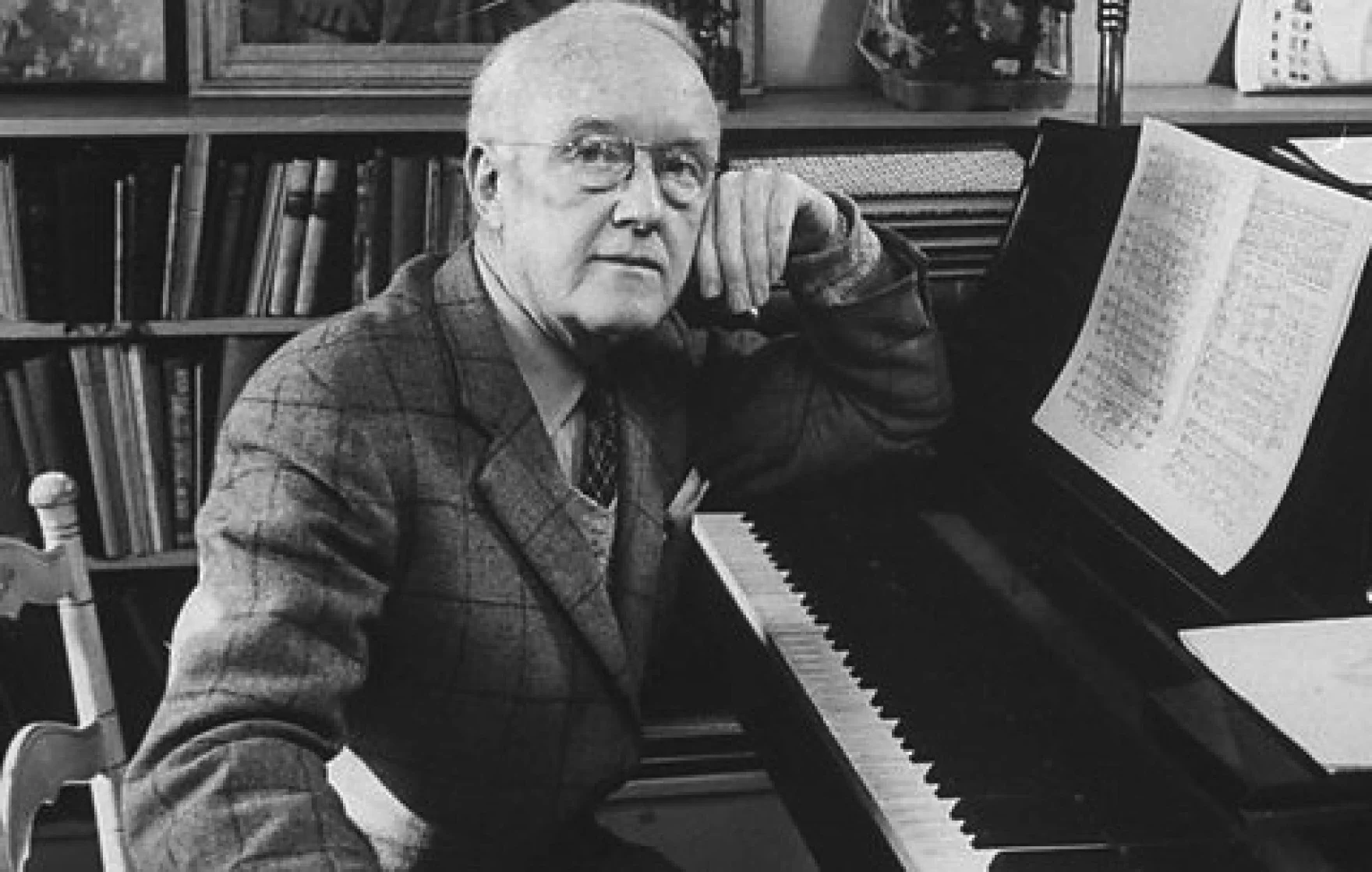
Randall Thompson
Chicago Chorale’s coming concerts are built around Randall Thompson’s major a cappella work, The Peaceable Kingdom, composed in 1936.
Thompson (1899-1984) was a native New Yorker and attended The Lawrenceville School, where his father was an English teacher. Later in life, he credited his emphasis on choral composition, and his intense interest in the study and choice of texts, to this background. He then attended Harvard University, became assistant professor of music and choir director at Wellesley College, and received a doctorate in music from the Eastman School of Music. He taught at the Curtis Institute of Music (serving as its Director 1941-42), the University of Virginia, and at Harvard University. His notable students included Leonard Bernstein (at both Harvard and Curtis), Samuel Adler, Leo Kraft, Thomas Beveridge, William P. Perry, Joel Cohen, and Christopher King.
The League of Composers commissioned Thompson in 1935 to write a major work for unaccompanied chorus. He chose as his point of departure a primitivist painting entitled “The Peaceable Kingdom” by Edward Hicks (1780-1849), “the preaching Quaker of Pennsylvania.” It illustrates Isaiah XI:6-9:
The wolf also shall dwell with the lamb, and the leopard shall lie down with the kid; and the calf and the young lion and the fatling together; and a little child shall lead them. And the cow and the bear shall feed; their young ones shall lie down together: and the lion shall eat straw like the ox. And the suckling child shall play on the hole of the asp, and the weaned child shall put his hand on the cockatrice’ den. They shall not hurt nor destroy in all my holy mountain: for the earth shall be full of the knowledge of the Lord, as the waters cover the sea.
In the middle distance, William Penn negotiates with the Indians by the shore of the Delaware River.
Inspired both by the painting and by the passage it illustrates, Thompson studied the book of Isaiah and selected eight passages referencing themes of peace, and of good versus evil. In general, Thompson’s compositional style is conservative-- he prefers triadic harmonies, melodic sequences, imitative passages, Renaissance modality, and Venetian polychoral texture—but the stark contrasts in the Isaiah text between good and evil, peace and war, death and life, inspire vivid, imaginative text-setting, appropriately dissonant harmonic passages, and large sections of recitative-like declamation, alternating with luscious, lyrical sections. He is able to express a variety of moods effectively, and keep interest and anticipation high. And the composer’s ordering of his text sets up a successfully dramatic narrative trajectory-- the work as a whole has a satisfying shape and arch, with a reassuring climax. I have had the opportunity to sing quite a lot of Thompson’s choral music over the years, and find this to be the most successful and satisfying of his major works—and also the freshest and most original, considering the passage of years since he was actively composing. “Primitivism,” with Thompson as well as with Hicks, refers to conception, rather than execution; both men have the sophistication and skill to accomplish major works, but are freed from the rigidity of their respective disciplines by Isaiah’s prophetic vision and language.
The remaining pieces on the program will highlight Thompson’s themes of the sorrow of separation, as well as the hope of ultimate peace and joy. We will sing two settings of Da pace, Domine (Give us peace, Lord) by Javier Centeno and Arvo Pärt; Super flumina Babylonis (By the waters of Babylon) by Palestrina; Media vita (In the midst of life we are in death) by Kerensa Briggs; Tonight Eternity Alone by Rene Clausen; Long, Long Ago by Herbert Howells; and Steven Paulus’ Pilgrims’ Hymn. A suitable subtitle for the concert might be: Music to strengthen and comfort us through hard times.